OmniRoute
A free switchboard for AI models: instead of wiring your app to OpenAI, Anthropic, and a dozen others separately, you point it at one address and OmniRoute figures out which AI provider to actually use, including free ones.
🔗 Visit OmniRoute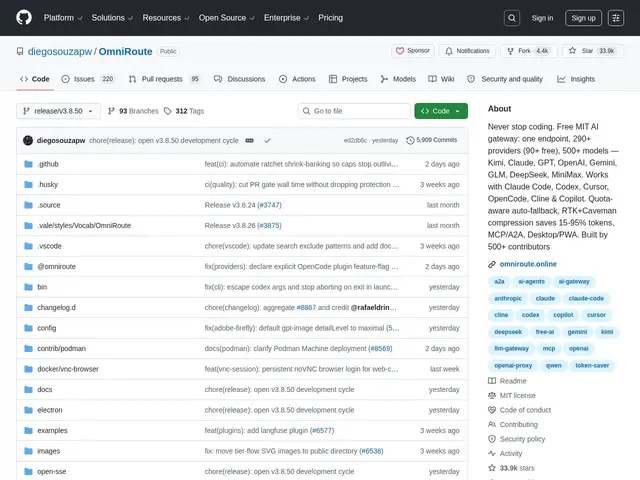
Description
If you build anything with AI models, you've probably hit the annoyance of juggling different providers — one API key and format for OpenAI, another for Anthropic, another for a cheaper open model — and manually switching when one is down or too expensive. OmniRoute is a free, self-hosted gateway that sits in front of 290+ AI providers behind a single, OpenAI-compatible endpoint, so your app talks to one thing and OmniRoute handles routing, fallback, and cost optimization behind the scenes.
It supports 19 routing strategies (priority, round-robin, cost-optimized, auto-scoring, fusion, pipeline), token compression that the project claims saves 15-95% of tokens via 12 stacked compression engines, and a three-layer resilience system (circuit breakers, connection cooldown, model lockout) so a failing provider doesn't take your app down with it. It aggregates roughly 1.53 billion free tokens/month across 90+ providers with free tiers (40+ free forever), works with 33 coding agents including Claude Code, Cursor, Cline, Continue, and Aider, ships an MCP server, REST API, webhooks, and remote CLI mode, runs on Node.js with Docker (AMD64/ARM64), Electron, and even Android Termux, and stores its local SQLite audit trail with optional Redis for scale. It's MIT-licensed with roughly 33.9k GitHub stars.
💬 Our review
The short version: if you're already juggling multiple AI provider API keys and eating outages or rate limits, OmniRoute's single-endpoint-with-automatic-fallback approach solves a real, common pain point, and it costs nothing to run yourself.
Compared to commercial AI gateways like OpenRouter or Portkey (hosted, easier to start with but you're trusting a third party's uptime and pricing markup), OmniRoute is self-hosted and free, which means more setup and operational responsibility on your end but no vendor lock-in or per-request fees beyond the underlying providers' own costs. Its token-compression claims (up to 95% reduction) are aggressive and worth testing on your own workload rather than taking at face value — compression ratios vary heavily by content type. For a solo developer or small team that already knows how to run a Docker container, the free-tier-aggregation angle (1.53B free tokens/month across 90+ providers) is a genuinely compelling reason to route through it even before considering paid providers.
💰 Pricing
📊 Global score
🤖 AI-enriched data
Open-source (licence MIT), auto-hébergé ; les coûts réels dépendent des fournisseurs IA utilisés derrière
Pros
290+ fournisseurs IA derrière un seul endpoint compatible OpenAI
19 stratégies de routage + résilience à 3 couches
Agrège ~1.53 milliard de tokens gratuits/mois sur 90+ fournisseurs
Compatible avec 33 agents de code (Claude Code, Cursor, Cline...)
Gratuit et open-source
Cons
Auto-hébergement requis, donc responsabilité opérationnelle plus lourde qu'un service géré
Chiffres de compression de tokens (jusqu'à 95%) à vérifier sur son propre usage
Nécessite une familiarité avec Docker/Node.js pour le déployer