Instatic
A free, self-hosted website builder you can run on your own server instead of paying monthly for Webflow — drag-and-drop pages, blog posts, and forms, plus an AI helper that can edit pages for you.
🔗 Visit Instatic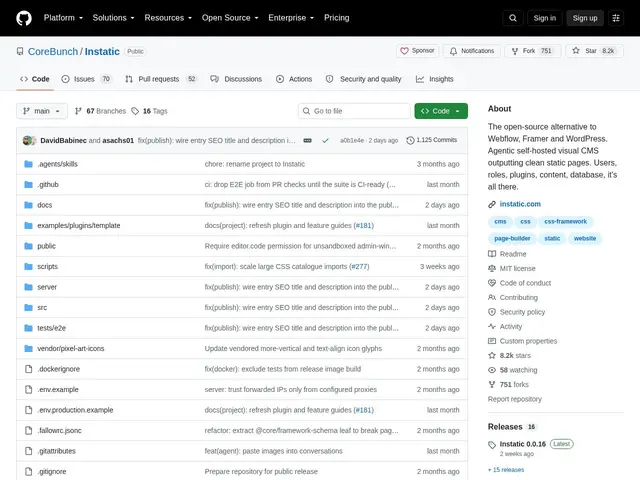
Description
Tools like Webflow or Framer let you build a website visually without code, but you're renting the platform forever and your site lives on their servers. Instatic offers the same visual, drag-and-drop page-building experience — walls of content blocks, live breakpoint editing, forms with submissions stored in a database — except you host it yourself, for free, and own the whole stack.
It combines a visual canvas editor, content management (pages, posts, custom collections), a form builder, and role-based access control (38 permission capabilities plus TOTP two-factor auth), with a built-in AI agent (provider-agnostic: works with Claude, OpenAI, OpenRouter, or a local Ollama model) that can build and edit pages on request. It's built with TypeScript, React 19 for the admin panel, and the Bun runtime, stores data in SQLite by default (or Postgres), generates static pages with in-memory caching, and supports a plugin system running in QuickJS-WASM sandboxes for safety. It deploys with one click to a VPS, Docker, Railway, or Render, is MIT-licensed, was built by the creators of Motion.page and Core Framework, and currently sits at pre-1.0 (version 0.0.x) with around 6.6k GitHub stars.
💬 Our review
The short version: if the idea of paying Webflow every month for something you could self-host for free appeals to you, and you don't mind a pre-1.0 product, Instatic is a legitimate open-source alternative with a real AI page-building feature on top.
Compared to Webflow or Framer (polished, mature, but recurring cost and vendor lock-in), Instatic trades some polish and hand-holding for zero recurring platform fees and full data ownership — a real tradeoff, not a free lunch, since you're now responsible for hosting and updates yourself. Against other open-source CMS options (WordPress, Strapi), Instatic's visual canvas editor and built-in AI agent are more modern conveniences, but the pre-1.0 version number is a genuine signal to expect rough edges and possible breaking changes before a stable 1.0. For a solo developer or small team comfortable with self-hosting and okay with some instability, it's worth trying; for a business that needs a website today with zero technical risk, a mature paid platform is still the safer choice.
💰 Pricing
📊 Global score
🤖 AI-enriched data
Open-source (licence MIT), auto-hébergé, aucun coût de plateforme récurrent
Pros
Éditeur visuel en canvas avec édition de breakpoints en direct
Agent IA intégré pour construire/éditer des pages (Claude, OpenAI, Ollama)
Contrôle d'accès granulaire (38 permissions) + 2FA TOTP
Gratuit, open-source, déploiement one-click (VPS, Docker, Railway, Render)
Cons
Encore en pré-1.0 (version 0.0.x), à attendre des évolutions/breaking changes
Nécessite de gérer soi-même l'hébergement (pas de service géré officiel)
Moins de polish et d'écosystème de templates qu'un Webflow mature