Prefactor
An observability and reliability layer for AI agents in production that scores every agent run in real time and can pause a risky one before it acts, with a free tier up to 25,000 spans/month.
🔗 Visit Prefactor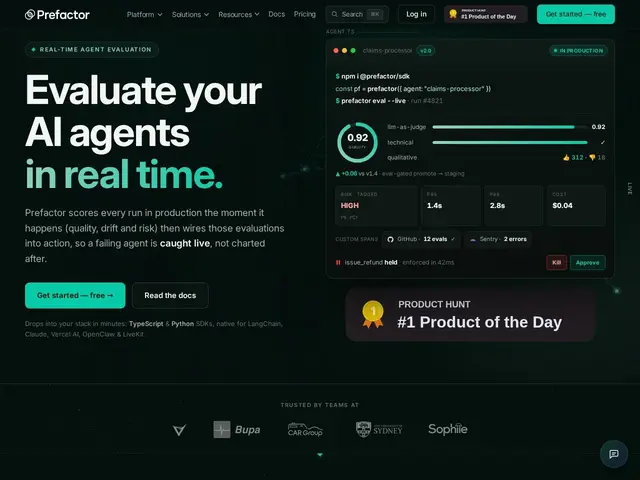
Description
An AI agent that works fine in testing can still go off the rails once it's live — calling the wrong tool, looping, or taking an action nobody approved — and by the time a dashboard shows the problem, it already happened. Prefactor tries to close that gap: it watches every agent run as it happens, scores it against rules you define, and can step in — pause, require approval, block — before a risky action completes, instead of just logging it afterward.
It plugs into LangChain, Claude, Vercel AI SDK, OpenClaw, and LiveKit via TypeScript and Python SDKs, giving a single control plane across every agent an organization runs, with visibility into ownership and operational metrics. The free Dev tier covers 25,000 spans/month, Scaleup starts at $250/month for 100k spans plus metered overage, and Enterprise scales to 4M+ spans/month with custom terms — aimed at teams in regulated industries (finance, healthcare, insurance) that need auditable access controls and approval workflows, not just after-the-fact dashboards.
💬 Our review
The short version: Prefactor's real differentiator is runtime intervention — most agent-observability tools show you what went wrong after the fact, but Prefactor can actually pause or block a risky action before it executes, which matters a lot more once agents have real write-access to production systems.
The free tier (25k spans/month) is generous enough to evaluate the product on a real integration before paying, and the framework-agnostic SDKs (LangChain, Claude, Vercel AI, OpenClaw, LiveKit) mean it isn't locked to one agent stack. The tradeoff is that this is infrastructure for teams already running agents in production with real stakes — a solo developer prototyping an agent doesn't need runtime policy enforcement yet. Compared to general LLM observability tools (LangSmith, Langfuse), Prefactor's enforcement layer is the harder feature to replicate, but also means more setup to define the policies worth enforcing.
💰 Pricing
📊 Global score
🤖 AI-enriched data
Dev gratuit (25k spans/mois) ; Scaleup 250$/mois (100k spans + 2,50$/1k) ou 9 600$/an ; Enterprise sur devis dès 4M+ spans/mois.
Pros
Intervention en temps réel (pause/blocage) avant l'action risquée, pas juste un log après coup
SDKs agnostiques au framework (LangChain, Claude, Vercel AI, OpenClaw, LiveKit)
Palier gratuit généreux (25k spans/mois) pour évaluer sur un vrai cas d'usage
Conçu pour les secteurs régulés avec workflows d'approbation auditable
Cons
Utile surtout à partir d'agents déjà en production avec de vrais enjeux
Nécessite de définir ses propres politiques d'évaluation pour tirer parti du blocage
Coût peut grimper vite au-delà du palier gratuit pour un volume élevé de traces