Crosslayer Labs
A web infrastructure security platform, founded by the Princeton team behind the internet's Multi-Perspective Issuance Corroboration standard, that detects and defends against impersonation attacks on websites and APIs.
🔗 Visit Crosslayer Labs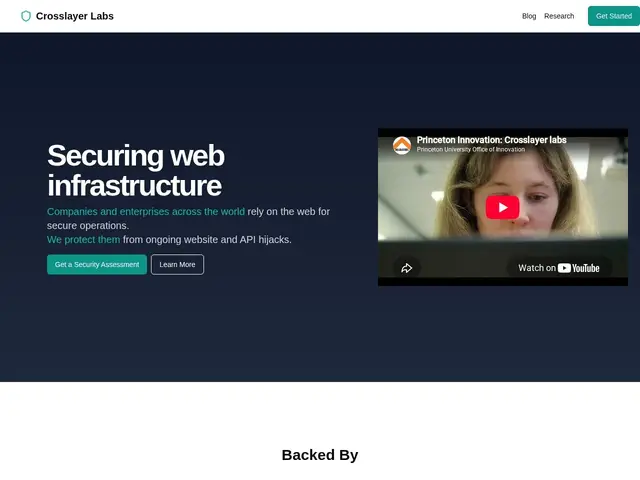
Description
Attacks that impersonate a legitimate website or API — hijacking DNS, forging TLS certificates, exploiting BGP routing — happen at layers of internet infrastructure most companies never monitor directly, because the tooling to watch DNS, BGP, TLS certs, and JavaScript dependencies all at once barely exists. Crosslayer Labs was built by the team that literally wrote the standard used to stop one class of these attacks: Multi-Perspective Issuance Corroboration (MPIC), now adopted by Google, Apple, and Amazon as certificate authorities, already securing HTTPS on 500+ million websites.
The platform maps a company's full attack surface and correlates signals across those infrastructure layers continuously, functioning as 'outside-in' monitoring — it watches how the internet sees your domains and APIs rather than only what's inside your own network. It's aimed at healthcare, cryptocurrency, and banking/fintech organizations, industries that are both high-value impersonation targets and typically under regulatory pressure to prove they monitor for this kind of attack. Pricing isn't published; access starts with a security assessment and a demo request rather than a self-serve signup.
💬 Our review
The short version: Crosslayer Labs' credibility is unusually concrete for a security startup — the founders invented MPIC, the actual internet standard now protecting HTTPS on 500+ million sites, so this isn't a team guessing at infrastructure security, it's the team that fixed one real vulnerability class at internet scale.
The lack of public pricing and demo-gated access means evaluating cost takes a sales conversation, which is standard for this category but still friction compared to a self-serve tool. The 'outside-in' monitoring approach — watching DNS, BGP, TLS, and JavaScript dependencies the way an attacker would see them — fills a real gap, since most internal security tooling only sees what's inside the network perimeter, not how the company's infrastructure looks from the outside. For healthcare, crypto, and fintech companies specifically named as target verticals, this kind of external-attack-surface visibility is a genuinely different layer of defense than a standard vulnerability scanner covers.
💰 Pricing
📊 Global score
🤖 AI-enriched data
Accès via évaluation de sécurité et démonstration, pas de grille tarifaire publique.
Pros
Fondateurs à l'origine du standard MPIC, déjà déployé par Google, Apple, Amazon
Surveillance 'outside-in' couvrant DNS, BGP, certificats TLS et JavaScript
Cartographie continue de la surface d'attaque
Ciblé sur les secteurs à forte valeur d'impersonation (santé, crypto, fintech)
Cons
Tarification non publique, accès via démo uniquement
Positionnement très vertical (santé/crypto/fintech), moins pertinent hors de ces secteurs
Startup récente malgré la crédibilité technique des fondateurs