Zudoku
A free, open-source framework for building interactive API documentation sites from an OpenAPI spec — built with React and Tailwind by the team behind Zuplo, for developers who want full control over their docs site's code rather than a hosted black box.
🔗 Visit Zudoku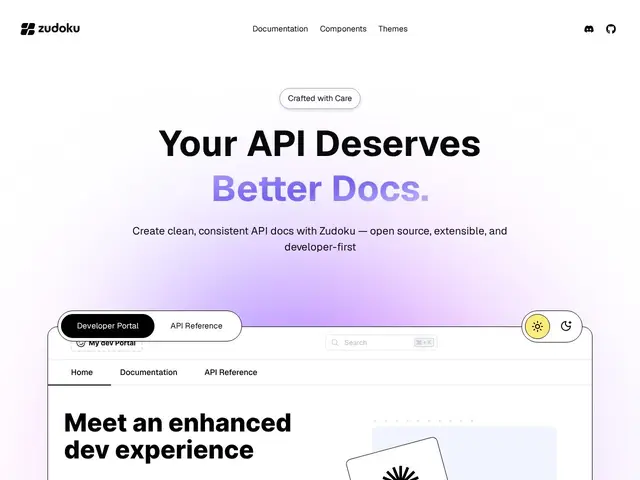
Description
Hosted API documentation tools are convenient, but they lock your docs into someone else's platform, pricing, and design constraints. Zudoku takes the opposite approach — a bit like choosing to build with an open framework instead of renting space in a walled garden — giving developers a codebase they own and can customize, deploy anywhere, and extend with plugins.
Zudoku is an open-source, MIT-licensed framework for generating interactive API documentation from OpenAPI (with GraphQL support coming) specs, built on React, TypeScript, and Tailwind CSS. It includes a built-in try-it playground, multi-API support, static site generation for fast page loads and good SEO, authentication integrations (Auth0, Clerk), and a plugin architecture for extending functionality. It deploys to any platform — Cloudflare Pages, Vercel, Netlify, AWS Lambda — rather than being tied to one host. It's free with no public pricing since there's no commercial product to sell; it's maintained by Zuplo (an API gateway company) as an open-source contribution to the ecosystem.
💬 Our review
The short version: if you want full control over your API docs' code, hosting, and customization without vendor lock-in, and you have (or don't mind having) a developer maintain it, Zudoku's open-source, framework-based approach is a legitimate alternative to paying a hosted docs platform monthly.
Being built and maintained by Zuplo — an established API gateway company, not a solo side project — gives Zudoku more credibility and expected longevity than a typical open-source docs framework, though it's still worth checking commit activity and issue response times before betting production docs on it. The tradeoff versus hosted platforms like Scalar, Mintlify, or ReadMe is real: you gain full control and zero subscription cost, but you take on hosting, updates, and any customization work yourself, since there's no vendor support line to call. For a team with existing frontend/React expertise that values ownership over convenience, that tradeoff favors Zudoku; for a team that just wants docs live today without engineering time, a hosted platform is the faster path.
💰 Pricing
📊 Global score
🤖 AI-enriched data
Projet open-source gratuit sous licence MIT, aucune offre commerciale.
Pros
Open-source et gratuit, sous licence MIT
Contrôle total sur le code, l'hébergement et la personnalisation
Maintenu par Zuplo, entreprise établie dans l'API gateway
Terrain de jeu (try-it) intégré et génération de site statique performant
Cons
Pas de support commercial ni de SLA
Nécessite des compétences frontend/React pour l'exploiter pleinement
Plus de travail de mise en place qu'une plateforme hébergée clé en main