PayKit SDK
An open-source TypeScript SDK that gives you one consistent API for Stripe, PayPal, Polar, Paystack and other payment providers, so switching providers later takes two lines of code instead of a rewrite.
🔗 Visit PayKit SDK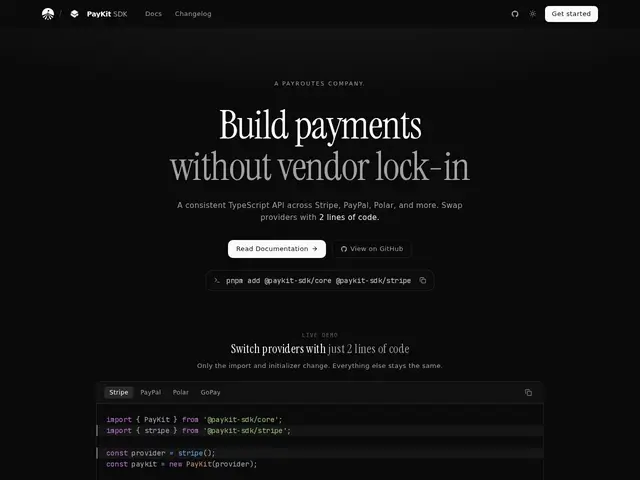
Description
If you've ever built checkout with Stripe and later needed to add PayPal, or wanted to switch providers because of fees or regional support, you know the pain: each payment provider has its own SDK, its own quirks, and rewriting checkout logic from scratch. PayKit acts like a universal power adapter for payments — you plug in whichever provider you need, and your code doesn't have to change shape to fit each one.
PayKit is an open-source TypeScript SDK that normalizes the integration surface across multiple payment providers (Stripe, PayPal, Polar, Paystack, and others) behind one unified API. Instead of coupling business logic to a specific provider's SDK, developers write against PayKit's abstraction and swap the underlying provider with a two-line config change — useful for multi-region businesses (Paystack for Africa, Stripe elsewhere), providers that reject an account, or teams hedging against vendor lock-in. It's free and open-source on GitHub, with no commercial tier disclosed, which also means no SLA or paid support — you're relying on community maintenance and your own read of the code.
💬 Our review
The short version: if you're building a product that needs to support more than one payment provider (multi-region, redundancy, or hedging against a provider ban), PayKit saves you from writing and maintaining that abstraction layer yourself — but check the GitHub repo's activity before betting production revenue on it.
Abstraction layers over payment APIs are a well-known pattern (companies build them internally all the time), but few are offered as an open-source package specifically for this. The value proposition is real for teams operating in multiple regions or wary of single-provider dependency. The risk is equally real: payment infrastructure is one of the worst places to depend on an unmaintained open-source project — a breaking change in Stripe's or PayPal's API that PayKit doesn't track quickly could break checkout in production. There's no visible pricing because there's no product to charge for; it's a library, not a hosted service, so you carry the maintenance burden if the maintainers move slower than the providers they wrap. For a single-provider integration, going directly against Stripe's or PayPal's own SDK remains simpler and better supported.
💰 Pricing
📊 Global score
🤖 AI-enriched data
SDK open-source gratuit (GitHub). Aucune offre commerciale, aucun support payant identifié.
Pros
API unifiée sur plusieurs fournisseurs de paiement (Stripe, PayPal, Polar, Paystack)
Changement de fournisseur en 2 lignes de code
Open-source et gratuit, code auditable
Utile pour le multi-région ou la redondance de fournisseur
Cons
Pas de support commercial ni de SLA — dépendance à la maintenance communautaire
Risque si PayKit prend du retard sur les évolutions d'API des fournisseurs qu'il enveloppe
Moins pertinent pour une intégration mono-fournisseur simple