Tipalti
An AI-powered finance automation platform that handles vendor invoices, mass payments to 200+ countries, expenses, and treasury for finance teams who'd otherwise be doing this by hand in spreadsheets and bank portals.
🔗 Visit Tipalti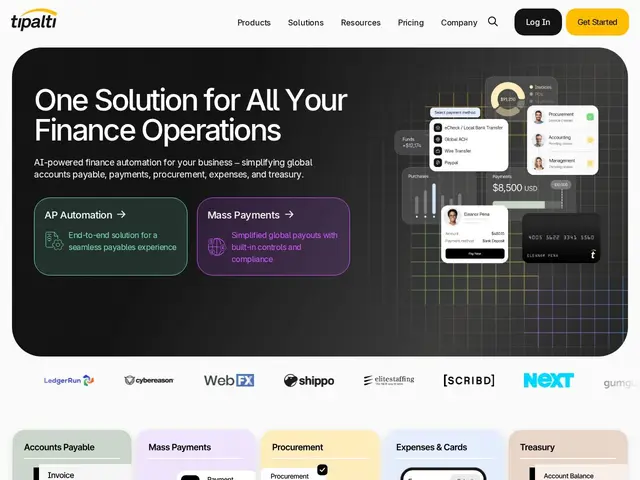
Description
Paying suppliers and contractors sounds simple until you're doing it across 30 countries, 120 currencies, and dozens of tax jurisdictions — at that point, manual invoice processing and wire transfers turn into a full-time job prone to errors and compliance risk. Tipalti automates that entire back office, the way a good accountant automates bookkeeping instead of doing it by hand.
Tipalti is an AI-powered accounts payable and mass payments platform that automatically processes vendor invoices, executes payments across 200+ countries and 120 currencies, and builds in tax and regulatory compliance (W-9/W-8BEN forms, OFAC checks) that would otherwise require dedicated compliance staff. It extends into procurement, expense management, and treasury/cash management as add-on modules. Pricing is transaction-subscription based: Accounts Payable starts at $99/month, Mass Payments at $249/month with unlimited users, and mid-market/enterprise customers get custom quotes for the fuller module set. It targets finance teams at larger organizations — adtech, e-commerce, SaaS, financial services — where global payables are a genuine operational burden, not a small SME wiring a handful of invoices a month.
💬 Our review
The short version: if your finance team is manually processing vendor invoices across multiple countries and currencies, Tipalti's automation and built-in compliance checks (tax forms, OFAC screening) can eliminate real headcount and error risk — but it's overkill and overpriced for a small business paying a handful of domestic vendors.
Tipalti's core strength is depth on the compliance side that generalist tools like Bill.com don't match as thoroughly — global tax form collection and sanctions screening baked into the payment flow matters a lot once you're paying contractors in dozens of countries. The $99-$249/month entry pricing looks affordable, but the real cost shows up once you add Procurement, Expenses, or Treasury modules at custom enterprise pricing — budget for a quote, not the sticker price. Compared to Airbase or Ramp, which lean more toward spend management and corporate cards for mid-market companies, Tipalti is specifically built for organizations with genuinely global vendor and payment needs; if your payables are mostly domestic, Bill.com or even your bank's ACH tools will be cheaper and simpler.
💰 Pricing
📊 Global score
🤖 AI-enriched data
Accounts Payable dès 99$/mois ; Mass Payments dès 249$/mois (utilisateurs illimités) ; modules Procurement/Expenses/Treasury et tarifs mid-market/enterprise sur devis.
Pros
Paiements automatisés dans 200+ pays et 120 devises
Conformité fiscale et réglementaire intégrée (formulaires fiscaux, contrôles OFAC)
Traitement automatique des factures fournisseurs par IA
Modules additionnels (Procurement, Expenses, Treasury) pour couvrir tout le back-office financier
Cons
Coût réel élevé une fois les modules additionnels ajoutés (tarifs sur devis)
Overkill pour une PME avec peu de fournisseurs, majoritairement domestiques
Complexité de mise en place proportionnelle à l'étendue des fonctionnalités