Autonomous Security
An endpoint security tool that finds every AI agent or assistant (like ChatGPT or Cursor) employees have installed on their work computers, and can stop them from taking risky actions.
🔗 Visit Autonomous Security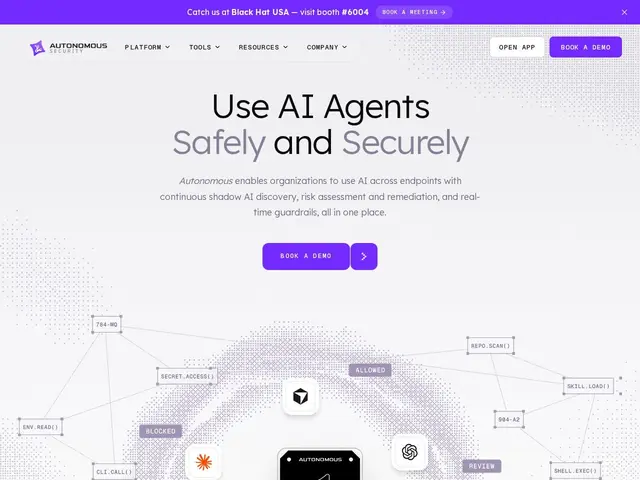
Description
Employees at most companies now install AI coding assistants, chatbots, and browser agents on their own initiative — often without IT ever knowing, a problem nicknamed "shadow AI." Autonomous Security is built to catch that: it scans company laptops to find every AI tool actually running, watches what those tools try to do, and can block risky or unauthorized actions in real time, the way antivirus software blocks malware.
Autonomous Security (a16y.ai) is an endpoint security platform purpose-built to secure AI agents at the workstation level. It combines Shadow AI Discovery (mapping every installed AI tool/agent across the fleet), Runtime Enforcement (blocking dangerous or unauthorized agent actions in real time), and Secure MCP Cloud (managing Model Context Protocol servers and integrations). It claims coverage of 50+ popular AI agents including Claude, ChatGPT, and Cursor, with a case study citing a public company running it across 4,000 workstations. Pricing isn't published; the company pushes demo requests.
💬 Our review
The short version: if your biggest AI-security blind spot is not knowing which AI tools your employees have already installed and what those tools can touch, a16y.ai's discovery-plus-enforcement approach targets exactly that gap at the endpoint level.
a16y.ai competes with the growing "AI agent security" cohort (Lasso Security, Onyx Security, SolonGate) but differentiates by focusing on the endpoint/workstation layer rather than the server-side MCP proxy layer some competitors target — it's closer to an EDR (endpoint detection and response) product retooled for AI agents than a network gateway. That's a genuinely different attack surface: shadow AI installed directly on laptops is invisible to server-side controls. The 4,000-workstation case study suggests it scales to real enterprise fleets, but as with the rest of this category, there's no public pricing and the market itself is under a year old, so long-term vendor stability is an open question worth diligence before a multi-year contract.
💰 Pricing
📊 Global score
🤖 AI-enriched data
Pas de tarification publique ; démo requise. Un témoignage cite un déploiement sur 4 000 postes.
Pros
Découvre les outils IA installés au niveau du poste de travail, angle mort des contrôles côté serveur
Blocage en temps réel des actions d'agent dangereuses (Runtime Enforcement)
Couvre 50+ agents IA populaires (Claude, ChatGPT, Cursor)
Déploiement à l'échelle prouvé (4 000 postes cité en référence)
Cons
Tarification totalement opaque
Marché très jeune (moins d'un an), stabilité du fournisseur à vérifier
Concurrence directe dense (Lasso, Onyx, SolonGate) sur un positionnement voisin