Wiz
A cloud security platform that maps how your code, cloud infrastructure, and running applications connect to each other into one picture, so security teams can see the actual attack path a hacker would take instead of chasing disconnected alerts.
🔗 Visit Wiz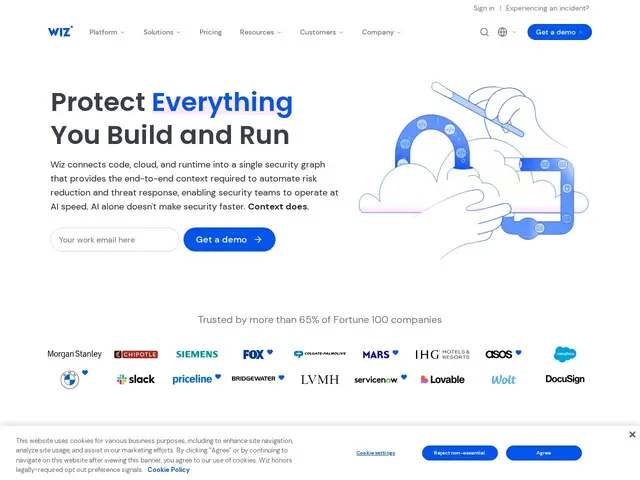
Description
Cloud security alerts are notoriously noisy — a scanner flags hundreds of "vulnerabilities" with no sense of which ones are actually reachable by an attacker versus buried behind three layers of protection that make them harmless. Wiz's core idea is to connect code, cloud configuration, and runtime behavior into a single security graph, so it can show which risks form a real attack path — not just a long list of theoretical issues.
That correlation-first approach is a big part of why Wiz has been adopted by 65% of the Fortune 100, according to the company, and why it's positioned for organizations managing complex, multi-layered cloud infrastructure and increasingly, AI applications, which introduce new attack surfaces most legacy scanners weren't built to understand. Pricing is entirely custom, scaling with workload volume, active developers, or log ingestion — there's no public number, and evaluating it starts with requesting a demo rather than self-serve signup.
💬 Our review
The short version: Wiz is worth a serious look if your security team is drowning in disconnected vulnerability alerts and needs to prioritize by actual attack path rather than raw severity score — that correlation is the platform's whole reason for existing.
Against CrowdStrike, which spans endpoint, identity, SIEM, and cloud in one unified platform, Wiz's center of gravity is specifically cloud-native security with code-to-runtime graph correlation — it goes deeper on cloud infrastructure risk but doesn't cover endpoint protection the way CrowdStrike does. The 65% Fortune 100 adoption figure is a meaningful trust signal, but it also signals enterprise-scale pricing and sales process — there's no way to get even a ballpark number without a demo, which is worth knowing going in if you're trying to quickly compare options. <!-- ai-generated -->
💰 Pricing
📊 Global score
🤖 AI-enriched data
Modulaire selon usage (workloads/devs/logs), aucun chiffre public
Pros
Graphe de sécurité code-cloud-runtime unifié
Priorisation par attack path réel
Forte adoption enterprise
Cons
Zéro tarif public
Ne couvre pas la protection endpoint