vCluster
Open-source tooling for creating fully isolated virtual Kubernetes clusters inside a single real cluster — each tenant gets what feels like their own Kubernetes, without the cost and overhead of actually running separate clusters.
🔗 Visit vCluster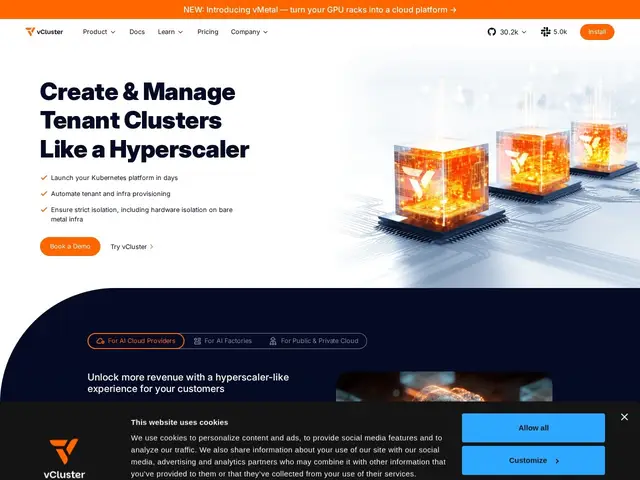
Description
Running a separate real Kubernetes cluster for every team, customer, or environment is expensive and slow to provision, but giving everyone shared access to one cluster raises obvious isolation problems — one tenant's mistake shouldn't be able to affect another's workloads. vCluster splits the difference: it creates lightweight virtual clusters inside a single physical Kubernetes cluster, so each tenant gets what looks and behaves like their own dedicated cluster and control plane, without the cost of standing up real infrastructure for each one.
It's become particularly relevant for AI cloud providers and enterprises that need to hand out isolated Kubernetes environments quickly — think giving each customer or each internal team their own sandboxed cluster on demand. The core tooling is open source and free, with a free tier covering up to 64 CPUs/32 GPUs of usage, and an Enterprise tier adding SSO, audit logging, and multi-region support for larger, security-conscious deployments including Fortune 500 customers.
💬 Our review
The short version: vCluster solves a specific, well-defined problem — 'I need many isolated Kubernetes environments without paying for many real clusters' — and does it as free, open-source software, which makes it worth trying before reaching for a heavier or paid alternative.
Against running genuinely separate physical clusters per tenant, vCluster is dramatically cheaper and faster to provision, at the cost of slightly weaker isolation guarantees than fully separate hardware (though still much stronger than shared-namespace multi-tenancy). Against other multi-tenancy approaches like namespace-based isolation, vCluster's virtual control planes give tenants much more autonomy — they can install their own CRDs and controllers without stepping on other tenants — which matters especially for AI cloud providers giving customers real infrastructure control. Being free and open-source for the core product means there's essentially no cost barrier to evaluating it against your actual multi-tenancy needs before deciding whether the Enterprise tier's SSO and compliance features are worth paying for. <!-- ai-generated -->
💰 Pricing
📊 Global score
🤖 AI-enriched data
Gratuit (open-source, jusqu'à 64 CPUs/32 GPUs) ; Enterprise sur mesure
Pros
Gratuit et open-source
Bien moins cher que des clusters séparés
Forte isolation et autonomie par tenant
Cons
Isolation légèrement inférieure à du hardware séparé
Enterprise sur devis
Nécessite une vraie expertise Kubernetes