Anomalo
A data quality platform that uses AI to automatically learn what 'normal' looks like in your tables and flags anomalies — without anyone having to write manual validation rules for every column.
🔗 Visit Anomalo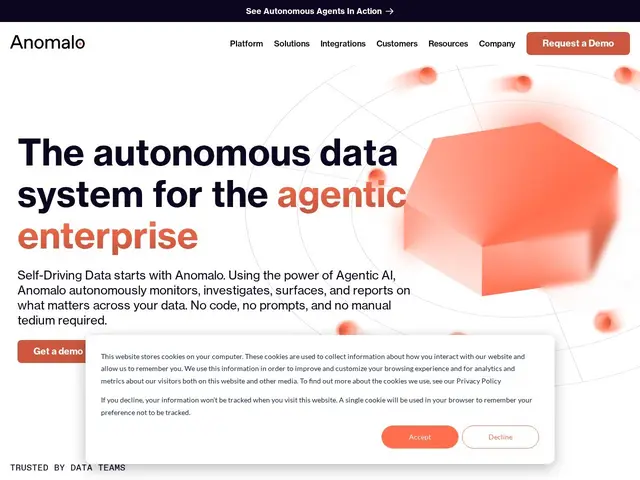
Description
Most data quality tools require someone to sit down and write a rule for every check: 'this column should never be null,' 'this number should never go negative.' That works until you have thousands of tables and nobody has time to write thousands of rules — which is the gap Anomalo is built to fill. It uses AI to automatically learn the normal patterns in your data and flag anomalies without requiring manual rule configuration for every table.
Anomalo runs a suite of AI agents that monitor data quality, detect anomalies, validate incoming data, and document pipelines, aimed at enterprise data teams who need broad coverage across large, fast-changing datasets rather than a handful of hand-picked critical tables. It's used across regulated and data-heavy industries — finance, telecom, retail, healthcare, media, and energy — where the assumption is that manually maintaining rules at scale simply isn't realistic. Pricing is enterprise-only, quoted through a sales conversation rather than published tiers.
💬 Our review
The short version: Anomalo is built for large organizations with too much data to monitor by hand, not for a small team that can write a handful of quality checks manually and call it done.
Against rule-based tools like Great Expectations or Soda, where you (or an engineer) explicitly define every check, Anomalo's automatic anomaly-learning approach trades some precision and control for coverage — it can watch far more tables than a team could realistically write rules for, at the cost of occasionally flagging things a human wouldn't have bothered checking. Against other enterprise data observability platforms like Monte Carlo or Bigeye, the differentiator is the specific ML-driven, no-configuration angle rather than lineage-and-alerting as the primary value. Because pricing is entirely quote-based with no published tiers, it's hard to comparison-shop without a sales call, which is a genuine friction point for teams trying to evaluate quickly — but for enterprises already committed to a formal vendor evaluation process, that's a normal part of the deal at this tier. <!-- ai-generated -->
💰 Pricing
📊 Global score
🤖 AI-enriched data
Modèle entreprise, tarification personnalisée via vente consultative
Pros
Détection d'anomalies sans configuration manuelle
Scalable à des milliers de tables
Agents IA spécialisés multiples
Cons
Pas de tarification publique
Moins de contrôle précis que des règles manuelles
Overkill pour petites équipes