Openbenchmarks for Agents
A free, independent scoreboard that actually tests AI agent tools and APIs against each other, so you can pick one based on real measured performance instead of marketing claims.
🔗 Visit Openbenchmarks for Agents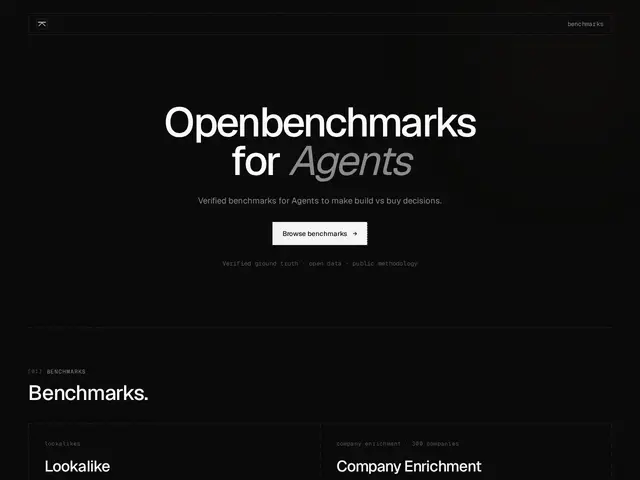
Description
Choosing between AI agent tools and APIs is hard because most of what you find is marketing copy from the vendors themselves — nobody advertises their own weaknesses. Openbenchmarks tries to fix that by acting as an independent third party: it runs standardized tests against real AI agent tooling and APIs, publishes the methodology openly so anyone can audit how a score was reached, and refuses funding or incentives from the vendors it evaluates to keep the comparisons honest.
Data is accessible for free through the website, a REST API with no authentication required, an OpenAPI 3.1 specification, and an MCP integration with OAuth 2.1 for agent-based access. Metrics include precision@10/25/100, latency, cost-per-relevant-result, and coverage, with LLM-based relevance scoring that includes a per-seed rationale so results are reproducible rather than a black-box number. Everything is published under a CC-BY-4.0 license, and data refreshes hourly.
💬 Our review
The short version: if you're trying to decide which AI agent API to build on and are tired of reading vendor benchmarks that conveniently favor the vendor publishing them, Openbenchmarks' independence and open methodology are the whole point.
Against reading a vendor's own published benchmarks, the obvious advantage is that Openbenchmarks explicitly rejects financial incentives from the companies it evaluates — a structural conflict of interest that in-house vendor benchmarks can't credibly avoid. Against informal community comparisons on forums or Twitter, Openbenchmarks offers reproducible methodology with per-seed scoring rationale, so you can actually audit why a score came out the way it did rather than trusting an anecdote. Since it's entirely free and openly licensed, there's no real cost-benefit tradeoff to weigh — the only caveat is coverage: if the specific tool or API you're evaluating isn't yet benchmarked, this becomes less useful than doing your own testing. <!-- ai-generated -->
💰 Pricing
📊 Global score
🤖 AI-enriched data
Accès gratuit et sans authentification via site web, API REST, et intégration MCP ; données sous licence CC-BY-4.0
Pros
Totalement gratuit, sans authentification requise
Refuse explicitement le financement des vendeurs évalués
Méthodologie ouverte et auditable avec justification par seed
Rafraîchissement horaire des données
Cons
Couverture limitée aux outils déjà benchmarkés
Projet indépendant récent, moins connu que les leaderboards des vendeurs
Scoring basé LLM implique toujours un jugement de modèle