KINETK
Turns what's happening across TikTok, Instagram, YouTube, Reddit, Pinterest, and X into a single queryable database, so a brand or app can ask "what's trending right now" and get a sourced, auditable answer instead of an AI guess.
🔗 Visit KINETK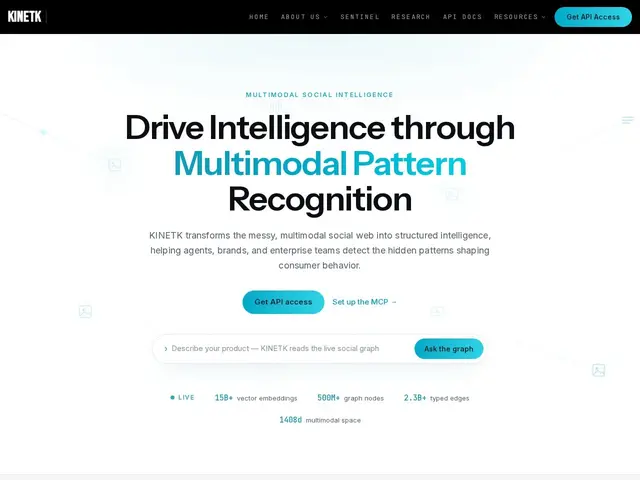
Description
Figuring out what's actually trending across social platforms right now usually means manually scrolling multiple apps, or trusting an AI chatbot's answer with no way to check where it came from. KINETK takes a different approach: it continuously ingests content from seven major social platforms and organizes it into a structured knowledge graph — over 500 million data points connected through 15 billion+ vector embeddings — so that when you ask a question, the answer comes from retrieving real, sourced content rather than an AI generating a plausible-sounding guess.
Developers access this through a REST API with API key authentication or through the Model Context Protocol (MCP) for direct integration into AI agents, with endpoints for trend discovery, narrative search and filtering, and async jobs for heavier data retrieval. The platform emphasizes auditability — every answer traces back to its source content in the graph — plus health monitoring endpoints for reliability in production use.
💬 Our review
The short version: if you're building a product or running an agency workflow that needs to know what's actually trending on social media right now — with a receipt showing where that answer came from — KINETK's knowledge-graph approach is built specifically to avoid the hallucination risk of asking a general AI chatbot the same question.
Against asking ChatGPT or a general LLM directly about current social trends, KINETK's real advantage is groundedness: answers are retrieved from an actual indexed graph of real posts, not generated from a model's training data, which matters a lot when accuracy on "right now" matters. Against a dedicated social listening tool like Brandwatch or Sprout Social, KINETK is more developer-facing — a raw API and MCP integration rather than a polished dashboard — which suits teams building their own product on top of the data but is less turnkey for a marketing team wanting a ready-made interface. The lack of public pricing is a real friction point: you can't evaluate cost-fit without contacting the team directly, which slows down the usual free-tier-first evaluation most API buyers expect. <!-- ai-generated -->
💰 Pricing
📊 Global score
🤖 AI-enriched data
Tarification non affichée publiquement, accès via inscription + clé API, contact requis pour un devis
Pros
Réponses sourcées depuis un vrai graphe, pas des suppositions IA
Couvre 7 plateformes sociales majeures unifiées
Support MCP pour intégration agents IA
Piste d'audit complète vers la source
Cons
Tarification non publique, contact obligatoire
API pour développeurs, pas de dashboard prêt à l'emploi
Plateforme récente, recul limité