os-dpt
A free, open-source SQL editor that runs entirely on your own machine and lets you ask database questions in plain English, with every query and piece of context saved as a git-trackable file instead of locked in someone's cloud account.
🔗 Visit os-dpt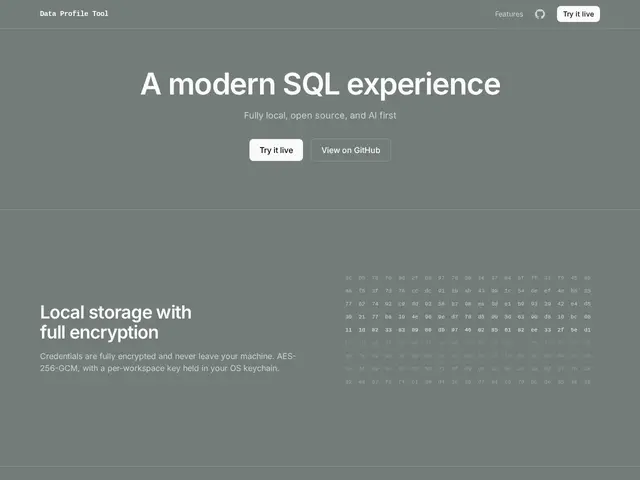
Description
Asking an AI to write SQL for you usually means sending your database schema and questions to a cloud service you don't control, which is a hard sell for anyone working with sensitive data. os-dpt takes the opposite approach: it's a SQL editor that runs locally on your computer (the server only binds to your own machine, 127.0.0.1), with a chat-to-SQL AI agent that writes and executes queries against your live schema in response to plain-English questions — but everything about how it works stays visible and under your control.
Queries live as plain .sql files and the agent's memory (schema notes, conventions, past feedback) lives as git-tracked markdown, so your query history gets normal version control instead of being trapped in an app's database. Database connections default to read-only, credentials are encrypted in your OS keychain, and results are automatically charted. It's installed via npm (npx os-dpt) and is free and open-source under the MIT license — you do need your own Anthropic API key for the AI agent to actually work.
💬 Our review
The short version: if you or your team need AI-assisted SQL help but can't (or don't want to) send your database schema to a third-party cloud service, os-dpt's local-first, open-source design is built specifically for that constraint.
Against a cloud-based chat-to-SQL tool, os-dpt's real advantage is that nothing about your schema or queries leaves your machine except the specific prompts sent to your own Anthropic API key — a materially different privacy posture for anyone with compliance requirements. Against a traditional SQL client like DBeaver or TablePlus, os-dpt trades some polish for the AI agent layer and git-native versioning of queries and context, which a traditional client doesn't offer. Being free and open-source removes any pricing risk, but you do carry your own Anthropic API usage cost, and as a smaller open-source project it lacks the maturity and plugin ecosystem of established SQL clients — worth trying for the privacy model specifically, less compelling if you don't care about that and just want the most polished SQL IDE available. <!-- ai-generated -->
💰 Pricing
📊 Global score
🤖 AI-enriched data
Gratuit sous licence MIT, nécessite une clé API Anthropic personnelle (coût d'usage séparé)
Pros
Gratuit et open-source (MIT)
Fonctionne localement, rien n'est envoyé sauf via votre propre clé API
Requêtes et contexte IA versionnés en git
Connexions en lecture seule par défaut, identifiants chiffrés
Cons
Nécessite votre propre clé API Anthropic (coût séparé)
Projet plus jeune, moins mature qu'un client SQL établi
Qualité de l'agent dépend du modèle connecté, pas un système propriétaire optimisé