Webhound
Does the tedious part of research for you — instead of spending days manually searching the web and copying results into a spreadsheet, you describe what you're looking for and it builds the dataset or report itself, with every fact linked back to its sou
🔗 Visit Webhound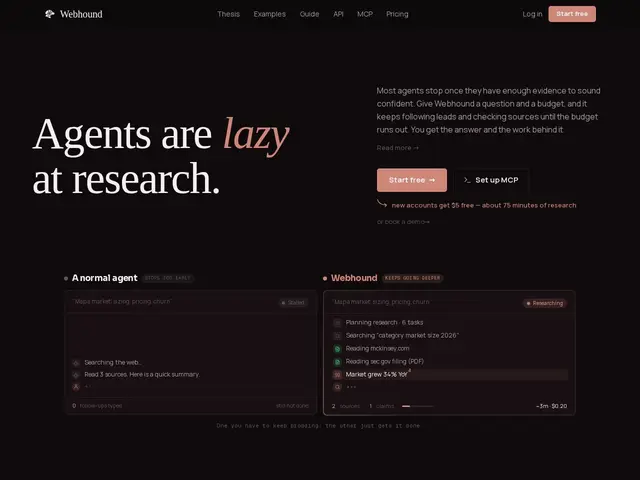
Description
Building a research dataset by hand — say, pricing for 200 competitors, or contact details for a list of companies — usually means days of manual searching, opening tabs, and copy-pasting into a spreadsheet. Webhound automates that entire loop: you describe what you're trying to find, and its AI agents figure out where to look, search in parallel, extract the results, and hand back a structured CSV or a fully cited report.
Webhound is a Y Combinator (S23) company built around "long-running" research agents — the idea being that research quality scales with how much time and budget you give the agent, rather than being capped at whatever a single search session can produce. A fleet of parallel search agents collects data simultaneously across multiple sources, and every claim in the output links back to the specific web source and tool call that produced it, which matters if you need to defend the numbers later. It offers multiple output modes (structured datasets, cited reports, an interactive "Ask" interface) and prices pay-as-you-go with no subscription commitment, so occasional use doesn't require a recurring bill.
💬 Our review
The short version: if you need a research dataset built from scattered web sources — competitor pricing, market lists, contact data — and you'd otherwise spend days doing it manually, Webhound's source-traceable output is the real selling point: you can actually verify where each data point came from, which most quick AI-summary tools don't offer.
It sits in a different lane from Perplexity, which is built for quick conversational answers rather than structured dataset construction, and from manual scraping tools like Clearbit or Hunter.io, which are narrower (contact/company data specifically) rather than general-purpose research. Webhound's tradeoff is transparency versus speed: because it runs long, parallel research jobs rather than a single quick query, it's not the tool for "answer this in 10 seconds" — it's for "build me something I'd otherwise spend a day building by hand." Pricing isn't fully transparent on the landing page beyond "pay-as-you-go," so budget-conscious teams should test on a small job first before committing to a large dataset build.
💰 Pricing
📊 Global score
🤖 AI-enriched data
Pay-as-you-go, pas d'engagement mensuel. Grille tarifaire détaillée non publiée sur la page d'accueil.
Pros
Chaque donnée du résultat est reliée à sa source web et à l'appel d'outil qui l'a produite (traçabilité)
Agents de recherche en parallèle : traite des recherches longues à grande échelle
Plusieurs formats de sortie (dataset, rapport cité, interface de questions)
Tarification à l'usage, pas d'abonnement à payer si usage ponctuel
Cons
Grille tarifaire précise non publiée, difficile d'estimer le coût à l'avance
Pas conçu pour des réponses rapides ponctuelles (contrairement à Perplexity)
Documentation publique limitée sur les capacités et limites de l'API
Site en rendu côté client, ce qui limite sa découvrabilité SEO