Superdesign
Lets a developer describe a screen in plain English and get real React and Tailwind code back, instead of a picture in a design tool that someone then has to rebuild by hand.
🔗 Visit Superdesign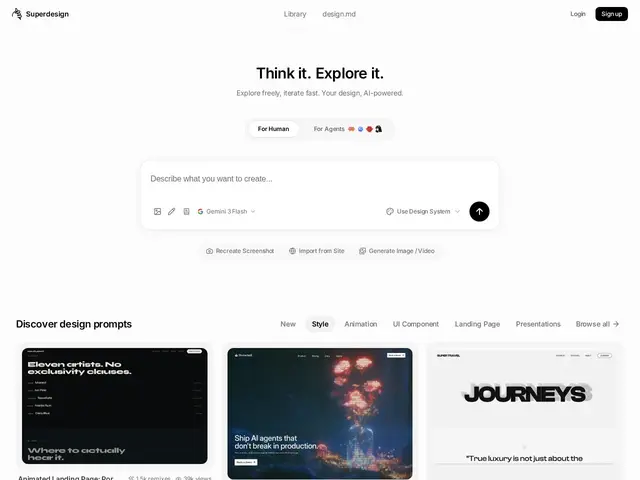
Description
The usual handoff between design and code goes: a designer builds a mockup in Figma, then a developer manually rebuilds it as actual code — a step that eats time and always loses some fidelity in translation. Superdesign skips that middle step. It's an AI design agent built for developers rather than designers: you describe what you want, and it generates the actual React and Tailwind code, not a picture you still have to recreate.
It works two ways: as a standalone web app with an infinite canvas for iterating on designs, and as an extension inside coding tools developers already use — Cursor, Windsurf, Claude Code, VS Code — so the design generation happens inside the same environment as the rest of the codebase, reading your existing design system rather than starting from a blank page. You can fork a design, iterate on variations, and export the code straight into your project. The open-source IDE extension has over 6,700 GitHub stars, though the company's focus has shifted toward the standalone web app; pricing is freemium, free to start with paid tiers for heavier use.
💬 Our review
The short version: for developers who'd rather skip Figma entirely and get straight to working code, Superdesign is a genuinely different approach from most AI design tools — it outputs code you own from the start, not a design file you still have to convert.
Against Figma itself, Superdesign isn't trying to replace collaborative design workflows — it has none of Figma's real-time multi-person editing or component library management, so teams with dedicated designers will still want Figma. Against v0.dev, which occupies similar code-first territory, Superdesign's edge is IDE integration — it plugs into Cursor, Claude Code, and VS Code directly rather than living as a separate web app you copy code out of. The catch: the original IDE extension is no longer the actively developed product (the team has moved focus to the web app), so if you were counting on deep IDE-native workflows specifically, check current maintenance status before betting on it. Worth it for solo developers or small teams without a dedicated designer; not a replacement for Figma if you need real design collaboration.
💰 Pricing
📊 Global score
🤖 AI-enriched data
Gratuit pour commencer, paliers payants disponibles pour usage intensif (détails non publiés en clair)
Pros
Génère du code React/Tailwind directement utilisable, pas juste une maquette
Intégration dans les IDE déjà utilisés (Cursor, Claude Code, VS Code, Windsurf)
Canvas infini pour itérer et forker des designs
Extension open-source avec plus de 6700 étoiles GitHub
Cons
L'extension IDE originelle n'est plus le produit activement développé (focus déplacé vers l'app web)
Aucune collaboration temps réel multi-personnes comme Figma
Qualité du design dépendante de la clarté du prompt
Produit relativement récent (mi-2025)