Rescript
Edit a podcast or video recording by deleting the words you don't want from a text transcript, and the audio or video cuts itself to match — entirely in your browser, without uploading the file anywhere.
🔗 Visit Rescript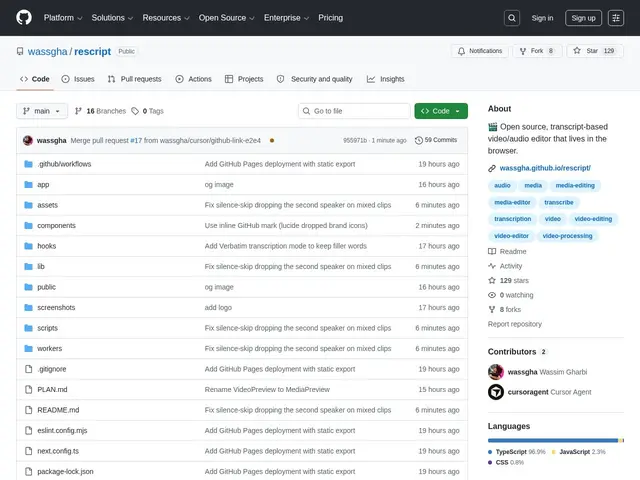
Description
Descript popularized the idea of editing audio and video by editing a text transcript instead of fiddling with a waveform — delete a word in the text, and the corresponding audio gets cut. It's genuinely faster than traditional editing, but it means uploading your recordings to Descript's servers. Rescript offers the same core workflow as a free, open-source, browser-based tool that never leaves your device.
Rescript transcribes your video or audio file and lets you edit by deleting words directly in the transcript, automatically cutting the corresponding media, with automatic filler-word removal (um, uh) and speaker identification/separation for multi-person recordings. It shows a visual timeline with waveform and cut regions plus a real-time preview of your edits, and exports directly to MP4 (video) or M4A (audio) from the browser. All processing happens on-device with no server uploads, which matters if you're editing anything sensitive or simply don't want to trust a cloud service with your raw recordings.
💬 Our review
The short version: if you like Descript's transcript-based editing workflow but don't want to upload your recordings to someone else's server (or pay a subscription), Rescript gives you the same core idea for free, entirely in your browser.
Descript remains far more feature-complete — Rescript is explicitly positioned as an open-source alternative, not a full replacement, so expect it to lack Descript's more advanced features (overdub, AI voice cloning, multitrack studio production) while nailing the core transcript-editing loop. For solo podcasters or anyone editing interview recordings who mainly wants to cut filler words and dead air by editing text, and who cares about privacy or just doesn't want a subscription, Rescript is a legitimate free option. Being a smaller open-source project (123 stars) means fewer resources than Descript's team, so expect rougher edges — but the core workflow reportedly works, with a live demo available before you commit to using it.
💰 Pricing
📊 Global score
🤖 AI-enriched data
100% gratuit et open-source (licence MIT)
Pros
Édition par transcript comme Descript, mais 100% gratuit
Traitement local, aucun upload serveur — confidentialité totale
Suppression automatique des mots de remplissage (um, uh)
Identification et séparation des locuteurs pour enregistrements multi-personnes
Cons
Moins complet que Descript (pas d'overdub, pas de clonage vocal IA)
Petit projet open-source (123 étoiles), moins de ressources qu'une équipe produit
Écosystème et support communautaire plus restreints
Fonctionnalités avancées de post-production absentes