Horus Runtime
A tool for scientists to build and run multi-step computing pipelines — like the kind used in drug discovery research — on shared university or lab computing clusters, without hand-writing fragile shell scripts for every step.
🔗 Visit Horus Runtime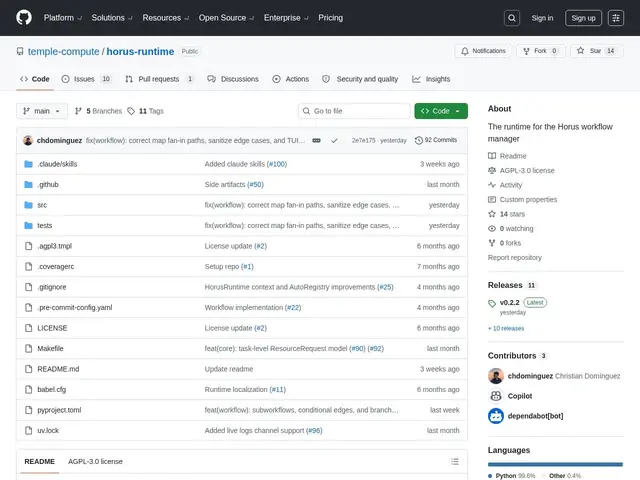
Description
Scientific computing pipelines, especially in fields like drug discovery, often chain together dozens of computational steps that need to run on shared HPC clusters accessed over SSH. Traditionally this means either fragile shell scripts that break when a step fails partway through, or heavyweight workflow systems that are overkill for a research lab. Horus Runtime aims for a middle ground built specifically around remote HPC execution.
Horus Runtime is a Python-based, terminal-first workflow engine for building and running scientific computing pipelines from modular, reusable blocks, with native support for remote execution over SSH and HPC clusters. It includes a Terminal User Interface (TUI) for managing running workflows, supports reproducible workflow sharing and versioning so a research group can pass around a validated pipeline, and has internationalization support. A companion project called Pantheon provides ready-made, production-quality workflows specifically for drug discovery research, suggesting Horus Runtime is being built as infrastructure for that domain first. It requires Python 3.13-3.14 and is AGPL-3.0 licensed.
💬 Our review
The short version: if you're a researcher running multi-step computational pipelines on HPC clusters — especially in drug discovery or molecular dynamics — and you're tired of shell scripts that silently break, Horus Runtime's modular, versioned workflow approach with native SSH/HPC support is worth evaluating alongside established tools like Nextflow or Snakemake.
Nextflow and Snakemake are far more established in the bioinformatics/scientific computing space with larger communities and more integrations — Horus Runtime's differentiator is its terminal-first TUI and its tight coupling to the companion Pantheon project's drug-discovery-specific workflows, suggesting a narrower but deeper focus on that domain rather than being a general-purpose workflow engine. With only 14 GitHub stars and 10 open issues, it's clearly earlier-stage and less battle-tested than Nextflow, so expect rougher edges and a smaller support community. The AGPL-3.0 license is also worth noting for institutions with restrictive open-source policies, since it has stronger copyleft requirements than the MIT/Apache licenses common in this space.
💰 Pricing
📊 Global score
🤖 AI-enriched data
100% gratuit et open-source (licence AGPL-3.0)
Pros
Support natif de l'exécution distante SSH/clusters HPC
Blocs de workflow modulaires et réutilisables
Interface TUI dédiée pour gérer les workflows en cours
Projet compagnon Pantheon avec workflows prêts pour la découverte de médicaments
Cons
Projet jeune (14 étoiles GitHub, 10 issues ouvertes), peu de recul
Moins établi que Nextflow ou Snakemake dans la bioinformatique
Licence AGPL-3.0 plus contraignante pour certaines institutions
Nécessite Python 3.13-3.14, contrainte de version stricte