Choreo
A way to describe web animations in a strict, limited language so an AI assistant can generate them reliably — and then automatically check that the animation actually rendered the way it was supposed to.
🔗 Visit Choreo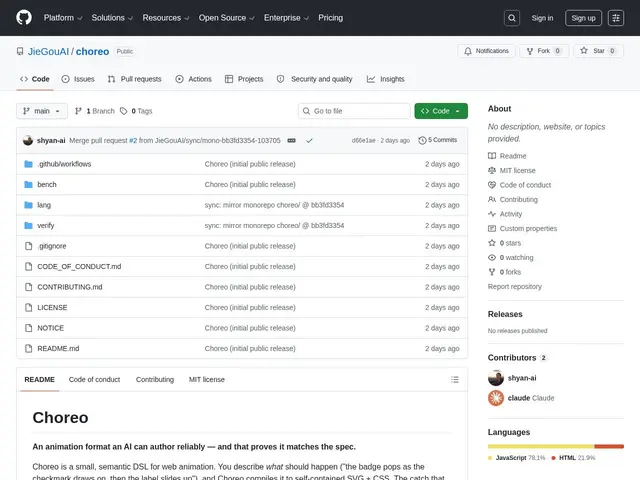
Description
Ask an AI coding assistant to write a CSS or JavaScript animation and you'll often get something that looks plausible in the code but doesn't quite render correctly — an element that's supposed to end at a specific position lands somewhere else, or timing that's off. Choreo tackles this by giving AI agents a much narrower, verifiable language to work in, so mistakes get caught automatically instead of shipping silently.
Choreo is a domain-specific language purpose-built for AI-generated web animations, with a bounded syntax specifically designed to be easy for language models to produce correctly. It compiles animations down to self-contained SVG and CSS, and pairs that with a verification system that checks "motion contracts" — spatio-temporal assertions — against the actual rendered pixel trace, catching cases where the generated animation doesn't match its intended behavior. The verification piece is also available standalone as the @choreo-oss/verify package, usable on any web animation regardless of how it was authored. It's released as a research artifact (MIT licensed) rather than a polished, supported product.
💬 Our review
The short version: if you're building AI agents that generate web animations and have been burned by code that compiles but renders wrong, Choreo's built-in verification against actual pixel output is a genuinely useful safety net that mainstream animation libraries don't offer.
It's not a replacement for GSAP, Framer Motion or Remotion for hand-written animation work — those remain more capable and better documented for human developers. Choreo's niche is specifically AI-authored animation correctness, and the standalone @choreo-oss/verify package is arguably the more broadly useful piece since it can validate animations built with any tool, not just Choreo's own DSL. Being released as a research artifact "as-is" means don't expect production support or long-term maintenance guarantees — treat it as a reference implementation of an idea (verifiable AI-generated animation) more than a tool to build a product on top of today.
💰 Pricing
📊 Global score
🤖 AI-enriched data
100% gratuit et open-source (licence MIT), publié comme artefact de recherche
Pros
Syntaxe volontairement restreinte pour fiabiliser la génération par IA
Vérification automatique du rendu réel contre le comportement attendu
Package de vérification utilisable indépendamment sur n'importe quelle animation
Compile vers SVG/CSS autonome, sans dépendance runtime lourde
Cons
Publié comme artefact de recherche, sans support ni maintenance garantie
Moins capable que GSAP ou Framer Motion pour de l'animation écrite à la main
Écosystème et documentation limités
Utilité concentrée sur le cas précis de la génération d'animation par IA