Radicle
GitHub and GitLab both put your code on someone else's central server — Radicle lets teams host and collaborate on Git repositories peer-to-peer instead, so no single company can lock you out, rate-limit you, or shut your project down.
🔗 Visit Radicle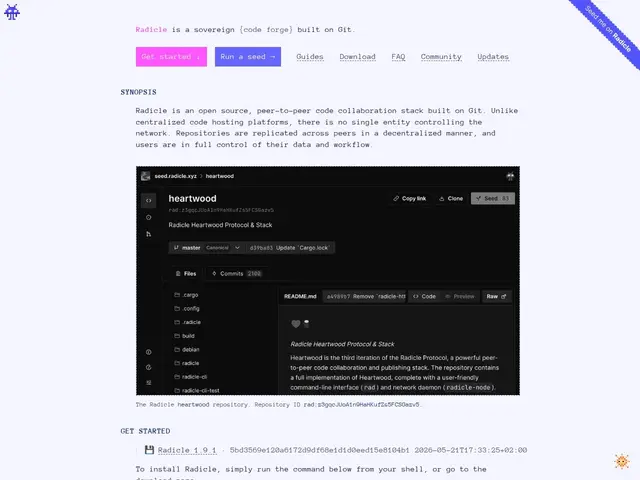
Description
Every mainstream code-hosting platform, however good, is still a single company's server: if it goes down, changes its pricing, or bans your account, your project's home goes with it. Radicle takes a different approach by making Git hosting genuinely peer-to-peer — your repository lives across a network of peers rather than one central server, so no single party controls access to it.
💬 Our review
The short version: Radicle is a serious, technically credible attempt at decentralized code hosting for developers who specifically want to avoid depending on a single company for something as fundamental as their source code — it's Git-native by design, not a bolt-on decentralization layer.
Against GitHub or GitLab (centralized but far more polished, with huge ecosystems of integrations and reviewers already there) or Gitea/Forgejo (self-hosted but still on a server you control and could be a single point of failure), Radicle's edge is that no one, including you, is a single point of failure for the network. The trade-off is real: the desktop client (Radicle Upstream) was sunsetted back in 2022, the main site can be flaky to reach directly, and you're mostly working through the rad CLI and the peer-to-peer network itself rather than a polished web UI — this is a tool for developers comfortable with the command line and decentralized-systems concepts. Worth it for teams or communities that genuinely prioritize sovereignty over convenience; not a drop-in replacement for GitHub if your team just wants issues, PRs and CI to work smoothly out of the box.
💰 Pricing
📊 Global score
🤖 AI-enriched data
Entièrement gratuit et open-source (Apache-2.0 / MIT), aucun palier commercial
Pros
Architecture pair-à-pair — aucun serveur central unique
Natif Git, écrit en Rust pour la sécurité et la performance
Gestion des issues et propositions directement dans le réseau P2P
Entièrement gratuit et open-source
Cons
Client bureau (Radicle Upstream) abandonné depuis 2022 — usage principal via CLI
Site web principal parfois difficile d'accès directement
Courbe d'apprentissage plus élevée que GitHub/GitLab pour les non-initiés au P2P