OpenCode
OpenCode was a free, open-source terminal coding agent that let you plug in any AI model instead of being locked to one vendor — it's now archived, with its team continuing development under a new name, Crush.
🔗 Visit OpenCode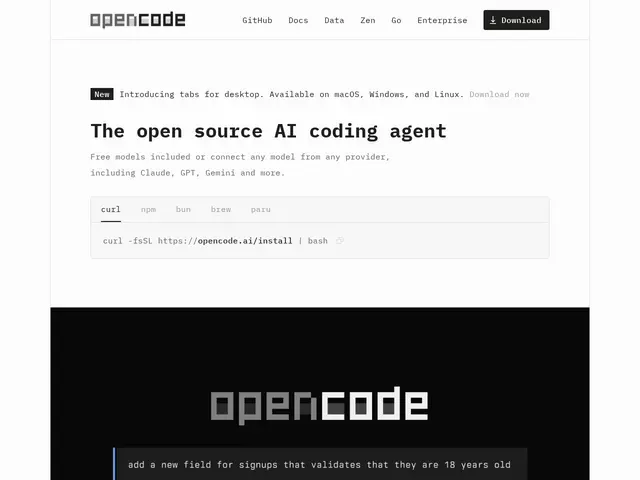
Description
AI coding agents that run in your terminal usually tie you to one company's model and pricing. OpenCode set out to fix that: an open-source agent you could run in the terminal, an IDE or a desktop app, connecting to 75+ LLM providers of your choice — OpenAI, Claude, Gemini, AWS Bedrock and more — without OpenCode itself storing your code or context.
It supported multi-session parallel agents, Language Server Protocol integration for code intelligence, shareable session links, and GitHub Copilot / ChatGPT Plus integration, all under an MIT license with 13.6k GitHub stars. However, the project was archived in September 2025, with its original team continuing development under a new name, Crush, at the Charm team. The GitHub repository and homepage remain publicly accessible, but OpenCode itself is no longer actively developed.
💬 Our review
The short version: OpenCode's model-agnostic, privacy-focused approach to terminal coding agents was genuinely well designed, but since it's archived, anyone considering it today should really be looking at its successor, Crush, instead.
Against GitHub Copilot (actively developed, deeply IDE-integrated, subscription) or Crush itself (the direct continuation of this exact project, same team, actively maintained), OpenCode's free, provider-agnostic design was its main appeal — but an archived project can't get security fixes or new features. Worth understanding as the origin of Crush and for anyone with an existing OpenCode setup that still works; new users should go straight to Crush or an actively maintained alternative instead.
💰 Pricing
📊 Global score
🤖 AI-enriched data
Gratuit et open-source (MIT) — projet archivé, succédé par Crush
Pros
Agnostique vis-à-vis du modèle IA — 75+ fournisseurs supportés
Multi-session, intégration LSP, liens de session partageables
Open-source MIT, communauté établie (13.6k étoiles)
Cons
Projet archivé depuis septembre 2025 — plus de développement actif
Succédé par Crush, qui devrait être le choix par défaut aujourd'hui
Pas de correctifs de sécurité à attendre