ApyHub
Instead of building and maintaining your own code for boring-but-necessary tasks — converting a file, validating an email, resizing an image — ApyHub gives you over 200 ready-made APIs behind a single login and a single bill.
🔗 Visit ApyHub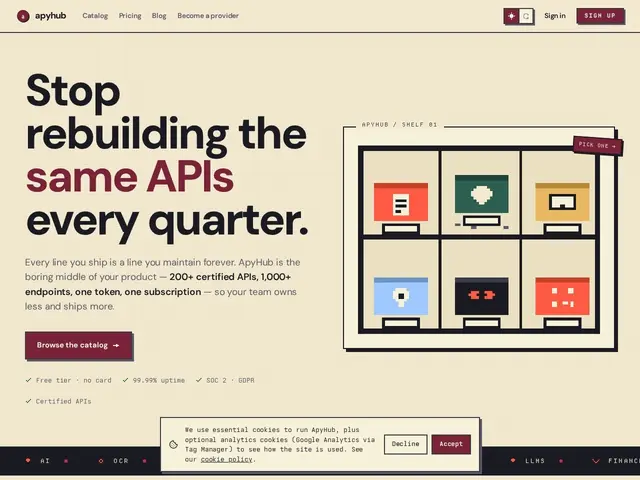
Description
Every product ends up needing a pile of small, unglamorous utilities: PDF generation, email validation, image resizing, text extraction, QR codes, and dozens more. Building and maintaining each of these in-house is a real, ongoing cost most teams underestimate. ApyHub's pitch is to be that "boring middle" of your product: 200+ certified APIs across 1,000+ endpoints, all callable with one token, so you plug in a function call instead of writing and patching your own service.
ApyHub covers categories like document processing, text/data utilities, image manipulation, and more, with code snippets in cURL, Node, Python, Go and Java, in-browser testing before you commit to integrating, and MCP-ready endpoints so AI coding agents like Claude can call them directly. Its APIs carry GDPR, SOC 2 and ISO 27001 certification, which matters for teams that need to vet vendors formally. Pricing is usage-based via a credit system ("atoms") with pay-as-you-go top-ups and a free tier to start — no per-API price negotiation.
💬 Our review
The short version: if your team keeps reinventing small utility functions (file conversion, validation, image processing) across projects, ApyHub's single-subscription API bundle is a legitimate way to stop maintaining that code yourselves.
Compared to stitching together individual specialized APIs yourself, or building serverless functions on AWS Lambda for the same tasks, ApyHub's edge is breadth and simplicity — one token, one bill, 200+ ready endpoints, versus juggling multiple vendors or writing your own. The trade-off is depth and control: a purpose-built specialist API (say, a dedicated PDF service) may offer more configuration than ApyHub's general version of the same function, and you're taking on a dependency on ApyHub's uptime for a wide swath of small features at once rather than spreading that risk. Its GDPR/SOC2/ISO27001 certification is a genuine plus for compliance-conscious teams evaluating vendors. Worth it for small teams that want to move fast without building utility infrastructure; teams with very specific, high-volume needs on a single function (e.g., heavy PDF generation) may still get better value from a dedicated specialist API.
💰 Pricing
📊 Global score
🤖 AI-enriched data
Palier gratuit disponible, puis facturation à l'usage via système de crédits ("atoms") avec recharges à la demande, pas de négociation par API
Pros
200+ APIs certifiées / 1000+ endpoints derrière un seul token
Certifications GDPR, SOC 2, ISO 27001 — utile pour la conformité fournisseur
Endpoints compatibles MCP pour agents de code IA
Test en navigateur avant intégration, snippets multi-langages
Cons
Moins de configuration fine qu'une API spécialisée dédiée à une seule tâche
Dépendance à la disponibilité d'ApyHub pour un grand nombre de fonctions à la fois
Pricing par crédits ('atoms') moins lisible qu'un prix fixe par appel
Pas idéal pour un besoin très volumineux sur une seule fonction spécifique