Routiium
A self-hosted proxy you put in front of your LLM API calls to get authentication, spending limits, multi-provider routing and a safety filter — without changing your app's code.
🔗 Visit Routiium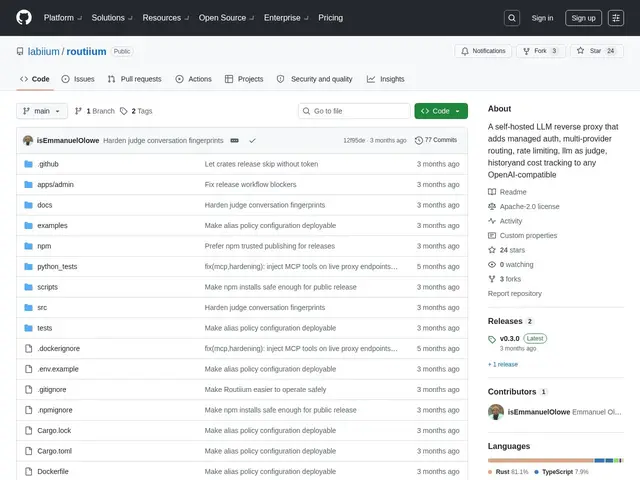
Description
If you're building anything on top of an LLM API, you eventually hit the same problems: how do you stop a leaked API key from running up a huge bill, how do you switch between OpenAI, a local Ollama model and AWS Bedrock without rewriting your app, and how do you stop a tool call from returning something dangerous straight into your next prompt? Routiium is a small piece of infrastructure that sits between your app and the LLM providers and handles exactly that — you point your code at Routiium instead of OpenAI directly, and it takes care of the rest.
Routiium is an open-source, self-hosted LLM reverse proxy, drop-in compatible with the OpenAI API format, that adds managed API keys (with expiration and revocation), routing across OpenAI, vLLM, Ollama and AWS Bedrock with cost/latency-based profiles (fast, balanced, secure, premium), rate limiting and concurrency controls, and a request/response "judge" that screens for prompt injection and blocks suspicious tool output before it reaches the model again. It's built in Rust with a Node.js/TypeScript admin panel, ships as a Docker deployment, and is licensed Apache 2.0 — genuinely free, self-hosted, and with no vendor lock-in.
💬 Our review
The short version: if you're running LLM calls in production and worried about cost blowouts, key leakage, or a malicious tool result poisoning your next prompt, Routiium is a legitimate self-hosted safety net that costs nothing but the server it runs on.
Its real differentiator against a managed gateway like Portkey or Helicone is that it's fully self-hosted and open source — nothing about your traffic or keys ever leaves your infrastructure, which matters if you're security-conscious or just don't want another SaaS bill. The tool-result guard is the standout feature: most LLM gateways focus on cost and routing, few actively screen what comes back from tool calls for injection attempts before it's fed back into the model. The catch is exactly what you'd expect from a young open-source infra project — it's a small repo (in the tens of GitHub stars at the time of writing), so you're trusting a not-yet-battle-tested codebase with production traffic, and you'll be running and patching it yourself rather than calling a support line. Fine for a technical team comfortable operating their own infra; not the choice if you want a zero-maintenance managed gateway.
💰 Pricing
📊 Global score
🤖 AI-enriched data
Auto-hébergé, licence Apache 2.0, aucun coût de licence — seul le coût du serveur qui l'exécute
Pros
100% auto-hébergé et open source (Apache 2.0) — aucune donnée ne sort de l'infrastructure de l'utilisateur
Garde-fou actif sur les résultats d'outils (détection d'injection de prompt) avant renvoi au modèle
Routage multi-fournisseurs (OpenAI, vLLM, Ollama, AWS Bedrock) avec profils coût/latence
Compatible drop-in avec l'API OpenAI — aucun changement de code applicatif nécessaire
Cons
Projet jeune, peu d'étoiles GitHub — pas encore éprouvé à grande échelle en production
Auto-hébergement = maintenance et mises à jour à la charge de l'équipe, pas de support commercial
Pas d'interface hébergée clé-en-main comme Portkey ou Helicone
Documentation en évolution rapide, risque de changements d'API entre versions