InvoiceShelf
A free, self-hosted alternative to invoicing SaaS like FreshBooks: create invoices and estimates, track expenses, accept card payments via Stripe, and keep every bit of financial data on your own server.
🔗 Visit InvoiceShelf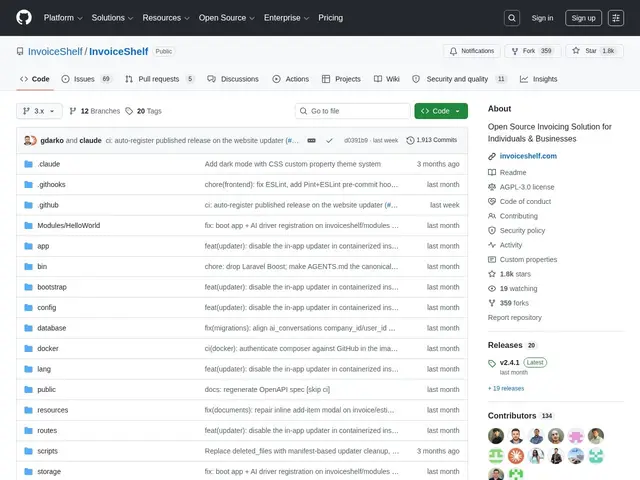
Description
Small business invoicing software usually comes as a monthly subscription that quietly grows more expensive as you add clients, companies, or team seats. InvoiceShelf takes a different approach: it's free software you install once on your own server and own outright, with no per-seat pricing and no vendor deciding to raise your bill next year.
InvoiceShelf is an open-source (AGPL-3.0) invoicing and expense-tracking application built on Laravel and Vue 3, distributed as a Docker Compose setup or a manual server install. It covers the core billing workflow a small business actually needs: branded invoices and estimates, expense recording, recurring billing for subscriptions or retainers, a customer portal where clients can view and pay invoices, Stripe integration for card payments, multi-company support with separate branding per entity, and a real-time dashboard for outstanding/overdue amounts. With roughly 1,800 GitHub stars and an active v3.x release cycle including a full TypeScript frontend refactor, it's a maintained, production-used project rather than a hobby repo.
💬 Our review
The short version: if you want FreshBooks-style invoicing and expense tracking but don't want to pay per seat forever or trust a third party with your client financial data, InvoiceShelf is the most complete open-source option available — it covers invoices, expenses, recurring billing, and card payments in one self-hosted package.
Against commercial SaaS like FreshBooks, Zoho Invoice, or Wave, InvoiceShelf gives up automatic updates, hosted infrastructure, and phone support in exchange for zero subscription cost and full data ownership — you run it on your own server (or a $5/month VPS), and there's no risk of a price hike or feature paywall down the line. Against Invio, its leaner open-source cousin, InvoiceShelf is the more complete pick when you actually need expense tracking, multi-company support, or Stripe payments rather than just sending a PDF and a link. The trade-off is operational: you (or someone on your team) are responsible for hosting, backups, and updates, which is a real cost for a non-technical small business owner even if the software itself is free. It's an excellent fit for a freelancer or agency comfortable with Docker who wants FreshBooks-level features without the FreshBooks bill; it's a poor fit for someone who wants to sign up and be invoicing in five minutes with zero server involved.
💰 Pricing
📊 Global score
🤖 AI-enriched data
Licence AGPL-3.0, gratuit, auto-hébergé uniquement (Docker Compose ou serveur manuel)
Pros
Gratuit et open-source, aucun frais par utilisateur
Facturation + dépenses + paiement Stripe intégrés
Multi-société avec branding séparé
Projet actif (~1800 étoiles, cycle v3.x en cours)
Cons
Auto-hébergement uniquement, pas de version SaaS officielle
Responsabilité de l'hébergement, des sauvegardes et des mises à jour
Demande des compétences serveur/Docker
Moins immédiat qu'un simple compte SaaS pour démarrer