DARE Engine
A shorthand language that lets an AI write 'make a table here, a bar chart there, a header up top' and get a clean, print-ready PDF out — without burning a huge chunk of its token budget describing HTML and CSS first.
🔗 Visit DARE Engine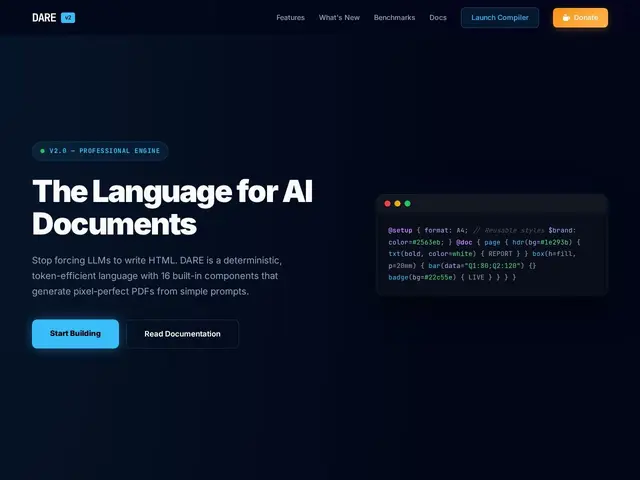
Description
When you ask an AI model to generate a PDF report or invoice, the usual approach is to have it write HTML and CSS, which is verbose — every table, spacing rule, and color has to be spelled out in markup the model has seen a million ways to write. DARE Engine's fix is a purpose-built, much terser language for exactly this one job: describing a printable document. The pitch is about 70% fewer tokens than the HTML equivalent, which matters directly for cost and speed when an AI agent is the one generating the document.
DARE Engine is a deterministic markup language with 16 built-in components (bar charts, pie charts, tables, badges, lists, links, headers, footers, and more), millimeter-based precise layout, and vector SVG chart rendering, compiled client-side in the browser to a PDF. It's MIT-licensed and open-source, aimed at developers building applications where an LLM needs to produce polished documents — invoices, reports, whitepapers — rather than raw HTML dumps. It includes a live browser-based compiler to test the language and system prompts designed to teach an LLM the DARE syntax directly.
💬 Our review
The short version: if you're building an AI agent that regularly outputs PDFs and you're paying per token, DARE Engine's terser syntax is a genuine cost and reliability lever compared to having a model hand-roll HTML/CSS for print layouts.
The niche here is narrow but real — most "AI generates a document" tooling either wraps a full HTML-to-PDF pipeline (heavier, more tokens, more room for the model to get formatting wrong) or a dedicated templating library that isn't AI-native. DARE's deterministic, component-based approach (tables, charts, badges as first-class primitives) trades general-purpose flexibility for predictability, which is usually the right trade when the output is going to a client as an invoice or report. Being free, open-source, and MIT-licensed removes the usual adoption risk, though as a young, fairly niche project it's worth checking how actively it's maintained and how its component set covers your specific document needs before betting a production pipeline on it. Skip it if you just need occasional, one-off PDF generation — a standard HTML-to-PDF library is simpler for that.
💰 Pricing
📊 Global score
🤖 AI-enriched data
Licence MIT, gratuit
Pros
~70% moins de tokens qu'un équivalent HTML pour générer un PDF
16 composants intégrés (tableaux, graphiques, badges…) pensés pour les documents
Rendu vectoriel SVG, mise en page précise au millimètre
Gratuit, open-source, licence MIT
Cons
Projet jeune et niche, écosystème/communauté limités
Overkill pour une génération de PDF ponctuelle et simple
Nécessite d'apprendre une syntaxe dédiée, même si conçue pour les LLM
Peu d'informations publiques sur la maintenance à long terme