Stage
A code review tool that turns a giant, confusing pull request into a short story you can read chapter by chapter, instead of one long wall of red-and-green diff lines.
🔗 Visit Stage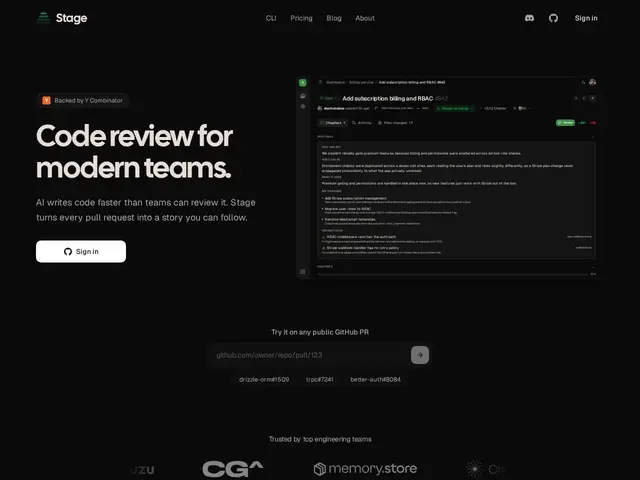
Description
Reviewing a pull request today usually means scrolling through a pile of changed files in whatever order Git happened to list them, trying to reconstruct in your head what the author was actually trying to do. That gets much harder now that a lot of code is written quickly by AI assistants, producing bigger diffs faster than humans can absorb them. Stage reorganizes a PR the way an editor reorganizes a rough draft into chapters: related changes get grouped and ordered so you read "first this happened, then this, then this," instead of an alphabetical file dump.
Under the hood, Stage connects to GitHub, analyzes the diff, automatically clusters related changes into logical chapters, and generates a PR summary alongside them. It includes an interactive chat assistant (called Stagent) for asking questions about the change, a reviewer dashboard, Slack connectivity, and — on paid tiers — private repo support, SSO, and audit logs. The free Starter tier covers open source and public projects; private repos need the Team plan.
💬 Our review
The short version: teams drowning in AI-generated PRs that are technically correct but hard to trust get real value from Stage's chapter view — but it doesn't replace a human's judgment on whether the change is a good idea, only makes the "what changed" part faster to absorb.
Compared to GitHub's native review UI (free, but presents diffs with zero narrative structure) or CodeRabbit and Graphite (which lean more on AI-generated line comments than restructuring the diff itself), Stage's differentiator is genuinely structural: it changes how the PR is read, not just what's annotated on top of it. That's a real, if narrow, idea — worth testing on a repo with consistently large or AI-authored PRs. At $30/user/month for private repos it's not cheap for a small team, and it's a new, single-purpose product from a team with limited public track record, so the honest move is to run it free on an open-source repo first and see if the chapter reorganization actually saves reading time before paying for private-repo access.
📊 Global score
🤖 AI-enriched data
Starter gratuit (projets open source/publics). Team 30 $/utilisateur/mois (dépôts privés). Enterprise sur devis (SSO, audit logs, revues de sécurité).
Pros
Réorganisation narrative des diffs en chapitres
Résumés et évaluations de risque générés par IA
Assistant de chat intégré (Stagent)
Gratuit pour l'open source
Cons
30 $/utilisateur/mois pour les dépôts privés
Ne remplace pas le jugement humain sur la qualité architecturale
Produit récent, peu de recul
SSO/audit réservés à l'offre Enterprise