OpenTrace
An open-source, self-hosted observability engine that gives AI coding agents direct access to production logs, metrics, and system context via the MCP protocol.
🔗 Visit OpenTrace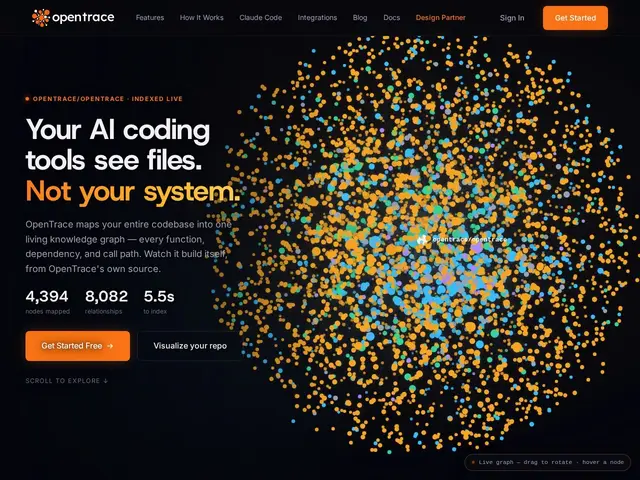
Description
When something breaks in production, an AI coding assistant is usually flying blind: it can read your code, but not what actually happened when a request failed at 3am. OpenTrace exists to close that gap by giving the agent itself a window into production, instead of you having to paste logs into the chat.
OpenTrace ingests logs, connects to databases, and monitors servers, exposing all of it to Claude, Cursor, and other MCP-compatible assistants so they can resolve errors, set up health checks, and save persistent notes across sessions. It runs on a custom columnar storage engine — no Elasticsearch, no heavyweight dependencies — capable of 200-500K entries per second, and it's designed to run cheaply, on a $4/month VM with one-click deployment on Railway, Render, or DigitalOcean. It automatically scrubs PII like card numbers, emails, and phone numbers before storage, and it's source-control and infrastructure agnostic (GitHub, GitLab, AWS, Kubernetes). It's free and open source (Apache 2.0/MIT), with an optional hosted tier for additional features at undisclosed pricing.
💬 Our review
The short version: OpenTrace is a compelling idea — let the AI agent query production directly instead of you copy-pasting logs into the chat — but it's a very young project (15 GitHub stars) without the track record of established observability tools yet, so treat it as an early adopter's bet rather than a safe default.
Against Datadog and traditional dashboards, OpenTrace's whole premise is different: there's no dashboard to stare at, because the AI assistant is the interface, which is either exactly what you want if you're already living inside Claude Code or Cursor, or a dealbreaker if your team still relies on visual dashboards for incident response. Against OpenTelemetry, which is a standard rather than a product, OpenTrace is an opinionated, ready-to-run implementation built specifically for the MCP/agent use case rather than general-purpose tracing. The $4/month self-hosting cost is genuinely appealing next to enterprise observability pricing, and the automatic PII scrubbing is a thoughtful touch for teams nervous about feeding production logs to an LLM. The tradeoff is maturity: with so few stars and limited documentation, you're relying on a small, unproven codebase for something touching production data.
📊 Global score
🤖 AI-enriched data
OSS gratuit (Apache 2.0 / MIT). Plateforme hébergée avec fonctionnalités supplémentaires disponible, prix non divulgué. Self-hosting possible dès 4 $/mois de VM.
Pros
Intégration native MCP avec tous les assistants de code IA majeurs
Self-hosted sur infrastructure minimale ($4/mois VM) avec déploiement one-click
Architecture columnar haute-performance (200-500K entrées/sec) sans dépendre d'Elasticsearch
Scrubbing PII automatisé (cartes bancaires, emails, numéros de téléphone)
Conception « no-dashboard » : l'agent IA est l'interface pour les insights production
Cons
Projet jeune (15 stars GitHub) avec communauté et documentation limitées
Écosystème adopteur limité comparé aux solutions commerciales établies
Pricing du mode hébergé non transparent