Krouter
A free, open-source traffic router for Kubernetes that handles web, gRPC, and other traffic types through one simple program, with zero downtime when it updates its rules.
🔗 Visit Krouter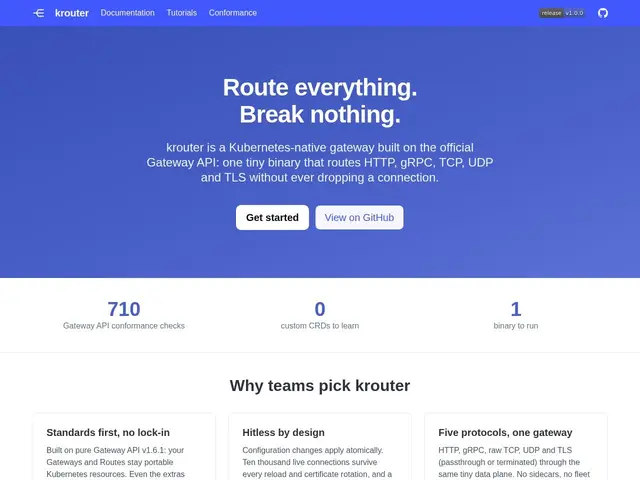
Description
Routing traffic into a Kubernetes cluster usually means choosing between several tools, each with its own custom configuration format, and hoping updates to routing rules don't cause a blip in traffic. Krouter is built to avoid both problems: it follows the standard Kubernetes Gateway API spec instead of inventing its own configuration, and it reloads routing rule changes without dropping any of the (up to 10,000) active connections.
It's a free, open-source (MIT) implementation of the Kubernetes Gateway API, distributed as a single binary with no custom CRDs required. It supports HTTP, gRPC, TCP, UDP, and TLS routing, reports full Gateway API conformance (710 checks, zero failures), and includes a built-in dashboard for real-time topology visualization along with security features like TLS termination, WAF, and per-route rate limiting.
💬 Our review
The short version: for teams running Kubernetes who want standards-compliant traffic routing without picking up a full service mesh's complexity, Krouter is a free, focused option worth evaluating.
Against Envoy Gateway and NGINX Gateway Fabric, both also free and Gateway API-compliant, Krouter's pitch is minimalism: one binary, no proprietary CRDs, native multi-protocol support out of the box. Against Traefik, which is easier to get started with but has historically leaned on its own configuration model, Krouter's strict Gateway API conformance (710/710 checks passing) is a meaningful selling point if standards compliance and portability across gateway implementations matter to your team. It deliberately doesn't do service mesh things — no retries, circuit breakers, or active health checks — so if you need those, you're pairing it with something else or picking Istio instead.
📊 Global score
🤖 AI-enriched data
Gratuit, licence MIT.
Pros
Aucune dépendance CRD propriétaire
Rechargements sans interruption
Support multi-protocole natif
Tableau de bord temps réel
Conformité Gateway API complète
Cons
Pas de fonctionnalités service mesh
Écosystème moins mature
Documentation limitée