Vitrin OS
A free, open-source system that lets AI agents use graphical apps on your computer safely, with strict permission controls and an instant human override.
🔗 Visit Vitrin OS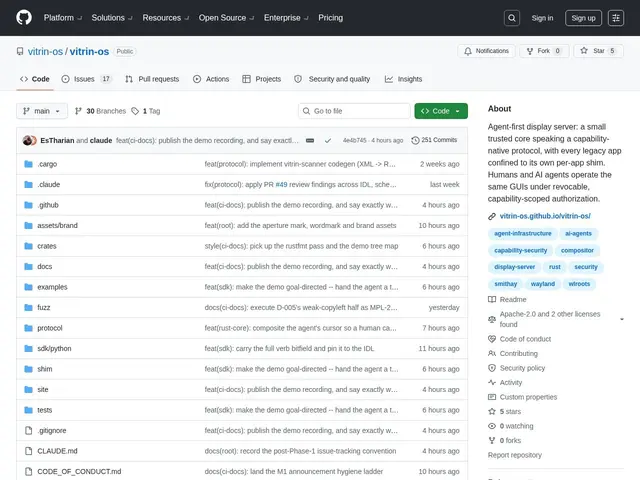
Description
As AI agents start doing more on a computer — clicking buttons, filling forms, browsing the web — the obvious risk is an agent doing something it shouldn't with full access to your screen and apps. Vitrin OS is built to solve exactly that: it gives each application its own sealed sandbox, requires explicit permission for anything an agent tries to do, and — crucially — any physical keyboard or mouse input from you instantly overrides and interrupts whatever the agent is doing.
It's an open-source project (Apache-2.0 for protocols/SDKs, MPL-2.0 for the core implementation, CC-BY-4.0 for documentation) built around a capability-based security model, using nested Wayland shims for per-application isolation on Linux. It ships SDKs in Rust, C, and Python, includes kernel-rendered consent prompts and an emergency stop that instantly revokes all agent authority, and Phase 1 already has working integrations for Firefox and terminal apps.
💬 Our review
The short version: this is a genuinely novel security approach for a real emerging problem — letting AI agents share a graphical desktop with a human safely — but it's Phase 1 of a multi-phase roadmap, so treat it as promising infrastructure to watch rather than something to deploy in production today.
There isn't a direct competitor built specifically for AI-agent desktop access with this security model; tools like Selenium automate browsers without any comparable permission or preemption system, and RDP/VNC servers or Wayland compositors give remote access without agent-aware capability controls at all. Vitrin OS's physical-input-preempts-agent design and instant kill switch are exactly the safety primitives this space needs, but the steep learning curve (Wayland internals, Rust/Meson toolchain), Linux-only requirement, and a still-limited set of compatible applications mean it's early adopter territory for now.
📊 Global score
🤖 AI-enriched data
Licence multi-source : Apache-2.0, MPL-2.0, CC-BY-4.0.
Pros
Sécurité basée capacités
Isolation stricte per-app
Préemption de l'entrée physique
SDK multi-langage
Coupure d'urgence instantanée
Cons
Projet jeune (Phase 1)
Courbe d'apprentissage élevée
Dépendances système imposées
Écosystème d'apps limité