code-review-graph
A free tool that builds a map of your codebase so AI code review tools need far fewer tokens to understand what changed — often 80x less.
🔗 Visit code-review-graph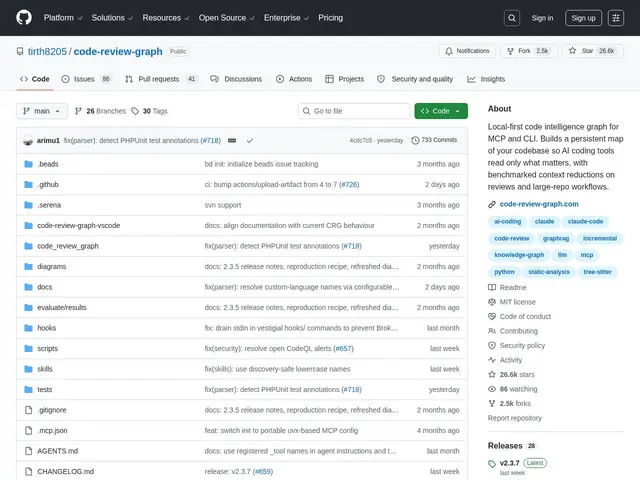
Description
AI code review tools work best when they understand the whole codebase, not just the lines that changed — but feeding an entire repository into an AI model every time is slow and expensive. code-review-graph solves this by building a persistent, local map of your code once, then updating it incrementally, so an AI reviewing a pull request can query "what does this function affect?" instead of reading every file from scratch.
It's an open-source (MIT) tool with 26,600+ GitHub stars, built on Tree-sitter to parse 30+ programming languages plus Jupyter notebooks into a local SQLite graph. It integrates via MCP with 30 available tools, supports blast-radius analysis to identify which files are affected by a change, and updates incrementally in under 2 seconds. Reported token savings are a median of ~82x (ranging 38x–528x depending on the repository tested).
💬 Our review
The short version: if you're paying per-token for AI code reviews on a large or actively-changing codebase, this can cut your review costs dramatically for zero license fee — the setup effort pays for itself fast at any real usage volume.
Against GitHub Copilot's review features and commercial tools like CodeRabbit, which typically re-scan diffs with limited persistent context, code-review-graph's local, persistent graph is a fundamentally different (and cheaper) approach to the same token-overhead problem — closer in spirit to what Sourcegraph does for code intelligence, but free, local-first, and MCP-native rather than a hosted enterprise product. The tradeoffs: it requires Python 3.10+ and initial MCP setup work, and its documentation and community are naturally less mature than commercial alternatives with dedicated support teams.
📊 Global score
🤖 AI-enriched data
Open source MIT, pas de version commerciale.
Pros
Réduction médiane de 82x des tokens
Support de 30+ langages + Jupyter
Intégration MCP avec 30 outils
Architecture locale SQLite persistante
Mises à jour incrémentielles < 2s
Analyse de blast-radius
Cons
Requiert Python 3.10+
Configuration MCP initiale nécessaire
Communauté moins établie que les alternatives commerciales