Orca
A free, open-source app that lets you run several AI coding agents — Claude Code, Copilot, Cursor — side by side in their own isolated copies of your project, so you can compare their results.
🔗 Visit Orca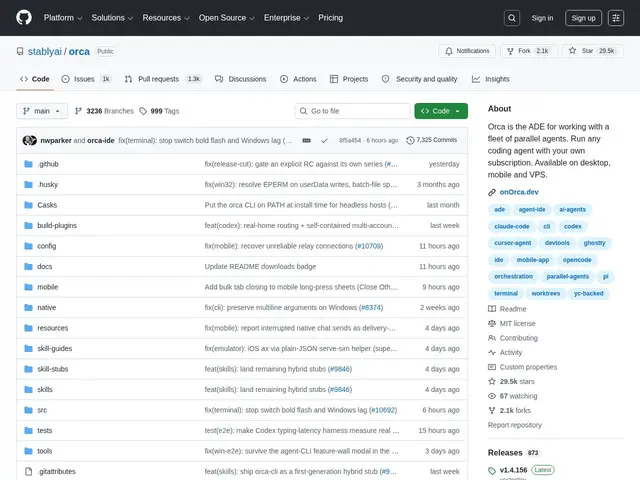
Description
When you ask one AI coding assistant to fix a bug, you get one answer, and you can't easily tell if a different model would have done better without redoing the work by hand. Orca solves that by giving each agent its own isolated sandbox copy of your codebase (a "worktree") to work in simultaneously, so you can run the same task through Claude Code, GitHub Copilot, Cursor, and a dozen other agents at once, then compare the results side by side and merge whichever one you like best.
Orca is an open-source (MIT) Electron and TypeScript desktop app backed by Y Combinator, with over 12,500 GitHub stars. It supports 20+ coding agents in parallel, each in its own git worktree, with a rich interface (terminal splits, a design mode, native GitHub and Linear integration) and a companion mobile app (iOS/Android) for remote monitoring of long-running agent tasks.
💬 Our review
The short version: if you're already paying for two or more coding agents and manually switching between them to see which does better on a given task, Orca automates that comparison for free and is worth trying today.
Against Cursor and GitHub Copilot, which are single-agent-per-editor tools, Orca's whole premise is different: it's not trying to be the best agent, it's trying to be the best way to run several agents you already pay for in parallel and pick a winner. That only pays off if you're already subscribed to more than one agent — Orca itself doesn't cover any of the underlying API/subscription costs. The project is young enough (despite its star count) that documentation gaps and learning curve for orchestrating multiple agents are real friction points, and being backed by a startup means roadmap direction could shift.
📊 Global score
🤖 AI-enriched data
Licence MIT, code source public, aucun frais. Hébergement auto-géré.
Pros
Exécution parallèle dans des worktrees isolés
Support de 20+ agents
Interface riche (terminal splits, design mode)
Backed by Y Combinator, 12.5k+ stars
Application mobile compagnon
Cons
Écosystème jeune
Courbe d'apprentissage importante
Dépendance aux agents tiers
Coûts API des agents non couverts