OpenSmith
A free, self-hosted tool that lets you see exactly what your AI application did step by step — without sending any of that data to a third-party cloud.
🔗 Visit OpenSmith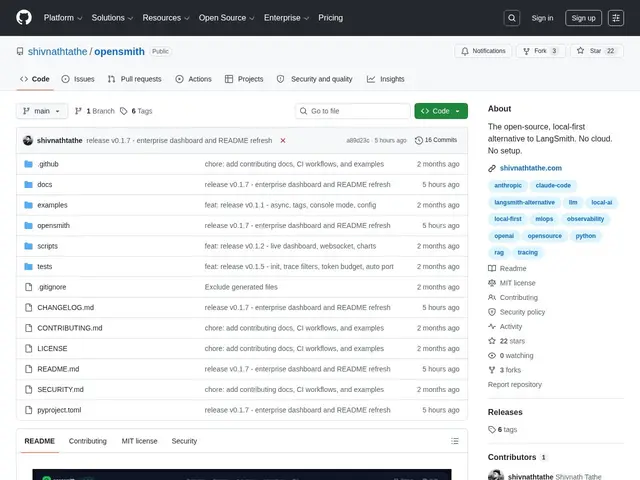
Description
When you're building an app powered by an LLM, something eventually goes wrong in a way that's hard to debug — a bad response, an unexpected cost spike, a chain of tool calls that went sideways. Tracing tools let you replay exactly what happened, but most of them are cloud services that require sending your application's data to someone else's servers. OpenSmith does the same job entirely on your own machine.
It's a free, open-source (MIT) Python tracing and observability tool for LLM pipelines, storing traces in a local SQLite database by default (with optional PostgreSQL). It offers decorators and context managers plus automatic patching for OpenAI, Anthropic, and LiteLLM calls, integrates with vector databases like Qdrant, ChromaDB, and Pinecone, and provides both a local web interface (port 7823) and a CLI for inspection, filtering, and export.
💬 Our review
The short version: if you're building LLM features and want LangSmith-style tracing without sending your prompts and data to LangSmith's cloud, OpenSmith is a free, self-hosted way to get most of the same visibility.
Against LangSmith itself, which is a polished managed service with a free tier and paid plans starting around $39/user/month, OpenSmith trades that polish and hosted convenience for total data control and zero cost — a clear win if privacy or budget is the priority, less so if you want a managed dashboard with a support team behind it. Against Arize or Phoenix (Arize's open-source arm), OpenSmith is narrower in scope but simpler to set up for a Python-only stack. The real limitations are being Python-only (3.10+) and export formats that are more basic (JSON/CSV) than what mature commercial dashboards offer.
📊 Global score
🤖 AI-enriched data
Gratuit à jamais, open source sous licence MIT, aucun coût de cloud.
Pros
Gratuit et open source
Architecture locale d'abord
Support multi-base de données
Intégrations étendues
Interface web + CLI
Cons
Limité à Python
Communauté en phase de maturité
Export limité vs SaaS