OpenLake
A free, open-source storage system that makes running large AI models cheaper by moving their working memory to fast storage instead of keeping it all in expensive GPU memory.
🔗 Visit OpenLake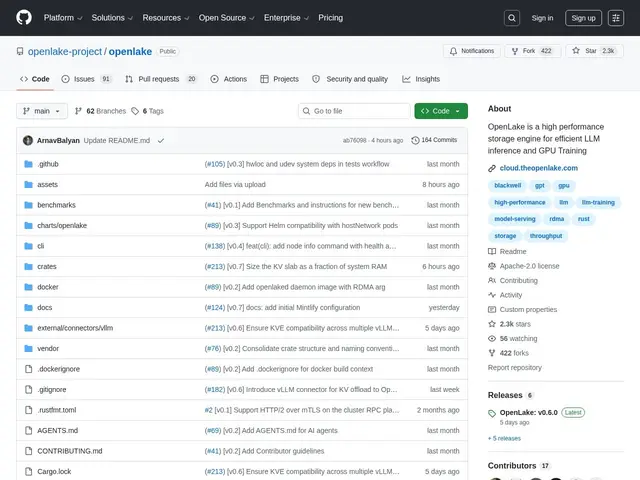
Description
Running large language models in production is expensive largely because of GPU memory — every ongoing conversation needs its "working memory" (the KV cache) held in fast, costly GPU RAM. OpenLake offers a way to offload that working memory to persistent storage instead, while keeping access fast enough that the model doesn't notice the difference, which can meaningfully cut the GPU memory bill.
It's a free, open-source (Apache 2.0) storage engine written in Rust, built on io_uring and RDMA to achieve sub-millisecond latency and over a million IOPS within a 1-millisecond window. It reports up to 50% lower LLM inference costs via KV cache offloading and a 66x speedup on time-to-first-token when reusing a cached 128K-token context. It integrates natively with vLLM and supports petabyte-scale storage for ML/RL checkpoints, vector indexing, and agentic systems.
💬 Our review
The short version: for teams running LLM inference at real scale and watching their GPU bill closely, OpenLake's free approach to offloading KV cache to storage is worth a serious pilot before assuming you need more GPUs.
Against vLLM, Ray Serve, or TensorRT-LLM — all free, open-source inference stacks in their own right — OpenLake isn't a competing inference engine, it's complementary infrastructure that plugs into vLLM specifically to extend how much context can be cached cost-effectively. That distinction matters: you'd add OpenLake alongside vLLM, not instead of it. The tradeoffs are real for anyone without a modern GPU infrastructure team already: it needs RDMA and io_uring tuning to hit its best numbers, requires GPU hardware like RTX or A100-class cards to see the full benefit, and — being a young project — has a still-forming community and limited production track record outside its own benchmarks.
📊 Global score
🤖 AI-enriched data
Apache 2.0, aucun coût commercial.
Pros
Réduit les coûts d'inférence jusqu'à 50%
Latence sub-milliseconde
Million+ IOPS en 1ms
Intégration vLLM native
Accélération 66x sur TTFT
Cons
Projet jeune, adoption limitée
Courbe d'apprentissage RDMA/GPU élevée
Nécessite infrastructure GPU moderne