Minnarone
A free Python framework for building AI agents that watch and react to live audio and video in real time, like monitoring a livestream or a meeting.
🔗 Visit Minnarone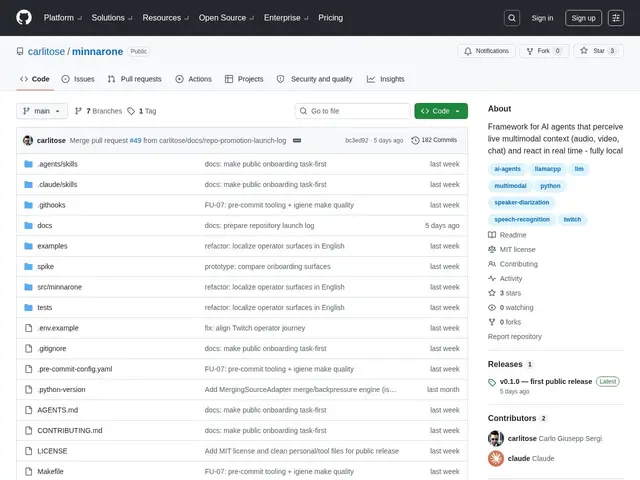
Description
Most AI agent frameworks work with text you type in and text that comes back out. Minnarone is built for a different situation: agents that need to perceive something happening live — a Twitch stream, a meeting audio feed, any real-time audio/video source — and react to it as it happens, the way a person watching over your shoulder would.
It's a free, open-source (MIT) Python framework combining speaker diarization (telling who's talking), speech recognition via faster-whisper, and vision inference via Qwen2-VL to generate reactive responses to live multimodal streams. It supports a "shadow" mode for testing without taking real action and a "live" mode with safety guardrails, and can run inference locally via llama.cpp or remotely via OpenRouter.
💬 Our review
The short version: this is a genuinely useful building block if you're an ML engineer building a live-perception agent — but it's a framework, not a finished product, so budget real integration time before it does anything useful for you.
Against general agent frameworks like LangChain Agents, AutoGPT, or Hugging Face Transformers Agents, which are mostly built around text-in/text-out workflows, Minnarone's focus on live multimodal streams (audio + video + chat simultaneously) is a meaningfully different and more specialized niche. The tradeoff for that specialization is a heavy dependency stack (Whisper, Qwen2-VL, sherpa-onnx) and real compute requirements for local inference, plus a project still in its acceptance-testing phase with a roadmap that isn't finalized — expect to do real engineering work, not just configuration, to get it running well.
📊 Global score
🤖 AI-enriched data
Open source MIT, gratuit à utiliser, déploiement libre.
Pros
Support natif de flux multimodaux en direct
Framework modulaire réutilisable
Mode shadow et mode live
Diarisation locuteur en temps réel
Infrastructure locale ou cloud
Cons
Dépendances Python lourdes
Encore en test d'acceptation
Ressources considérables nécessaires