Codebase Memory MCP
A free tool that lets AI coding assistants understand your entire codebase's structure instantly, instead of reading files one by one, cutting token usage by about 99%.
🔗 Visit Codebase Memory MCP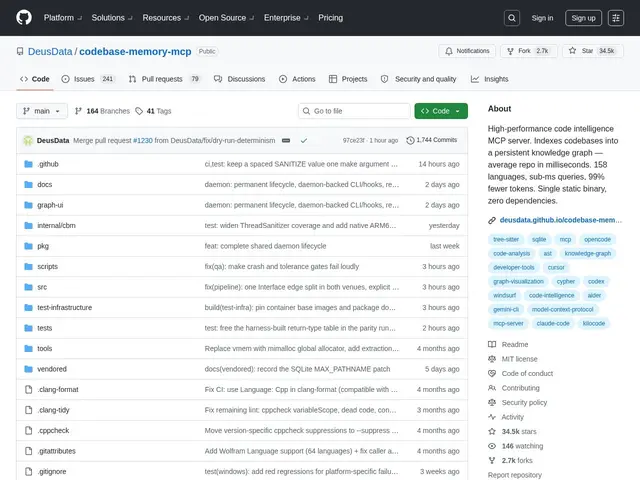
Description
When an AI assistant needs to understand how your code is organized, the naive approach is to feed it file after file — slow, expensive, and it still might miss how things connect. Codebase Memory MCP instead reads through your project once, builds a structured map of how everything relates (which function calls which, which file depends on which), and then answers questions about that map in milliseconds instead of re-reading raw text.
It's a free, open-source (MIT) MCP server supporting 158 programming languages via Tree-sitter, distributed as a single static binary with no runtime dependencies. It indexes fast (the Linux kernel, 28 million lines of code, in about 3 minutes) and answers queries in sub-millisecond time via openCypher, a graph query language. It's compatible with Claude Code, Cursor, VS Code, Zed, and other MCP clients, and the project reports about 99% fewer tokens used compared to naive file-by-file context stuffing.
💬 Our review
The short version: if your AI assistant keeps burning tokens re-reading the same large codebase for context, this pays for itself (it's free) the first time it saves you a blown context window.
Compared to plain Tree-sitter or ctags/LSP-based tooling, which give you syntax structure but not a persistent, queryable graph, Codebase Memory MCP goes a step further by keeping that structure around and queryable via openCypher across sessions. Against Sourcegraph, which offers similar architectural navigation as a hosted enterprise product, this is free, local, and installs as a single binary — a much lower-friction option for individual developers or small teams, at the cost of Sourcegraph's polish, hosted search UI, and dedicated support. The learning curve for writing your own Cypher queries is the main real cost here.
📊 Global score
🤖 AI-enriched data
Licence MIT, libre de droit.
Pros
Support de 158 langages
Requêtes sub-milliseconde
Réduction de 99% des tokens
Binaire statique sans dépendances
Indexation ultra-rapide
Compatible nombreux clients MCP
Cons
Courbe d'apprentissage Cypher
Nécessite synchronisation avec le code réel
Graphe 3D optionnel demande des ressources