Tower
A Python-native orchestration platform for running data pipelines, dbt workflows, and AI agents on either serverless or self-hosted infrastructure.
🔗 Visit Tower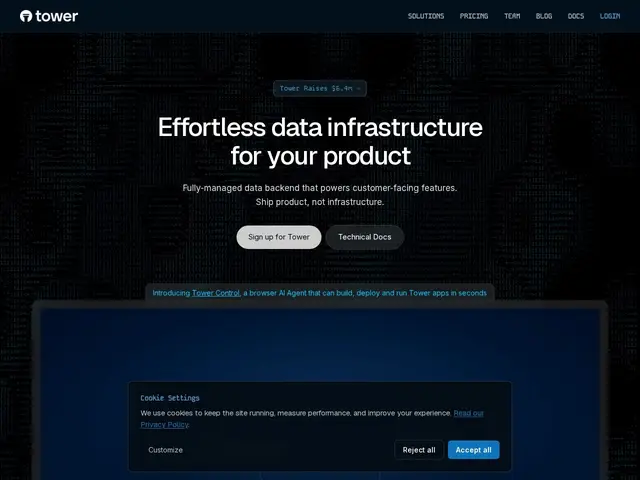
Description
Data teams that live in Python often end up bolting their pipelines onto orchestration tools built primarily for other languages or for a specific cloud vendor, which means fighting the platform as much as building the pipeline. Tower is built the other way around: Python is the primary interface, and the orchestration layer is designed to get out of the way.
Tower runs ETL/ELT pipelines, dbt workflows, and AI agents, and integrates natively with popular data tools like Polars, Apache DataFusion, and dltHub. It supports two deployment models — a managed serverless service, or self-hosted runners for teams that need data to stay on-premises — and includes an optional Apache Iceberg-based open lakehouse with automated table maintenance. It's positioned as AI-ready, with MCP server support and integrations for LangChain, Hugging Face, and Ollama, plus unified observability (logs, metrics, alerts, scheduling) in one platform. Pricing details aren't published on the main site.
💬 Our review
The short version: for data teams that want a Python-first orchestrator without committing fully to a single cloud vendor's ecosystem, Tower's dual serverless/self-hosted model and native dbt/dltHub/Polars support make it a credible pick, though the lack of public pricing is a real friction point before you can evaluate it seriously.
Against Airbyte and Fivetran, which focus mainly on managed data connectors, Tower is closer to a full orchestration layer that happens to also handle ingestion — more comparable to Prefect or Dagster in scope. Against dbt Cloud, Tower's advantage is that it isn't tied to the dbt ecosystem alone; it treats dbt as one workflow type among several, alongside general Python pipelines and AI agents. The self-hosted option for data sovereignty is a meaningful differentiator for regulated industries (manufacturing, healthcare-adjacent AI services) that can't put everything in someone else's cloud. What's missing is transparency: without published pricing or a clear list of the '700+' data sources some materials imply, teams have to talk to sales before knowing if it fits their budget, which is a bigger ask than competitors that publish self-serve pricing.
📊 Global score
🤖 AI-enriched data
Structure tarifaire non détaillée publiquement ; service managé serverless et runners self-hosted pour déploiements on-premises disponibles.
Pros
Orchestration Python-native avec intégration dltHub, Polars, Apache DataFusion
Double déploiement : serverless managé ou self-hosted pour la souveraineté des données
Lakehouse Apache Iceberg intégré avec maintenance automatisée des tables
AI-ready : support MCP server, LangChain, HuggingFace, Ollama
Observabilité unifiée : logs, métriques, alertes, scheduling
Cons
Détails tarifaires non transparents sur le site public
Liste précise des connecteurs de données non vérifiable sur la page d'accueil
Peu d'informations sur les limites du tier gratuit vs payant