Libretto
An open-source browser automation CLI that turns website workflows into reusable, typed scripts for developers and AI agents.
🔗 Visit Libretto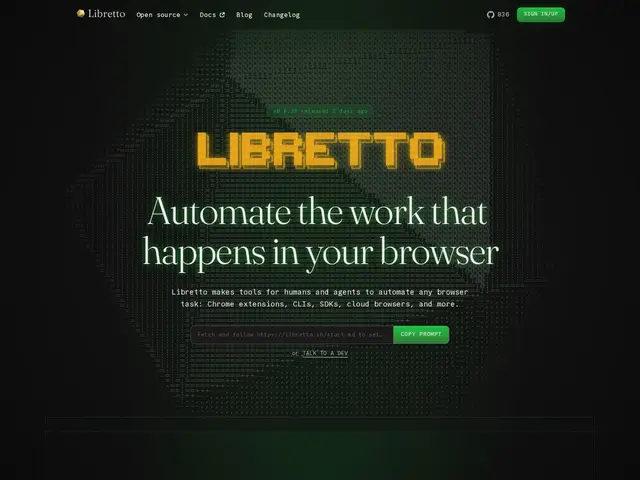
Description
If you've ever had to keep a script working against a website that changes its layout every few months, you know the pain: the moment a button moves or a class name changes, your automation breaks. Libretto tackles that problem for browser automation — it watches a workflow run once successfully, then generates a script that reproduces it, and it tries to make that script as resilient and as cheap to run as possible.
Libretto is a free, open-source CLI (install via `npx libretto open`) built by the team at Saffron Health after a year spent maintaining automations against fragile EHR and payer portals. It generates typed Playwright/TypeScript code validated with Zod schemas, and — its standout feature — reverse-engineers the network traffic behind a successful run to produce a direct HTTP version that skips the browser UI entirely, which the team claims cuts execution cost by about 55% ($0.106 vs $0.235–$0.293 per run in their benchmarks). A built-in debugging agent inspects failed automations and can open pull requests with fixes. It ships an SDK with six browser-control tools for AI agents, and is actively maintained on GitHub and Discord.
💬 Our review
The short version: if you're already comfortable with Playwright or Puppeteer and just want scripts that write themselves from a recorded run, Libretto is worth trying — it's free, open source, and the network-level reverse-engineering trick is a genuinely useful cost optimization that competitors don't really offer.
Against Playwright and Puppeteer directly, Libretto isn't a replacement so much as a code generator sitting on top of the same ecosystem — you still get Playwright/TypeScript output, just produced automatically instead of hand-written. Against Selenium, it's simply more modern and less brittle. The real differentiator is the HTTP-reverse-engineering step: turning a browser automation into a direct API call when possible is the kind of optimization that saves real money at scale, and the built-in debug agent that proposes fixes for broken automations is a rare touch for an open-source tool this young. The catch is exactly that youth — it launched publicly around October 2025, so it hasn't had years to prove itself against edge cases the way Playwright has, and public documentation on the network-reverse-engineering and auto-fix agent is still thin. For teams maintaining fragile scraping or portal automations who are willing to be early adopters, it's a low-risk bet since it costs nothing to try.
📊 Global score
🤖 AI-enriched data
Entièrement gratuit et open source (GitHub : saffron-health/libretto). Installation via `npx libretto open`, aucun coût caché.
Pros
Génère du code Playwright/TypeScript typé Zod à partir d'un run réussi
Reverse-engineering du trafic réseau vers une version HTTP directe, ~55% moins coûteuse
Agent de debug intégré qui propose des PR de correction pour les automations cassées
SDK Browser Tools avec 6 outils pour agents IA
Open source, gratuit, support actif (Discord, GitHub)
Cons
Projet jeune (public depuis oct. 2025), moins éprouvé que Playwright/Selenium
Documentation limitée sur le reverse-engineering réseau et l'agent de correction