Claude Reflect
A self-learning plugin for Claude Code that captures your corrections and repeated workflow patterns, then syncs them into CLAUDE.md and config files so the agent remembers them across sessions.
🔗 Visit Claude Reflect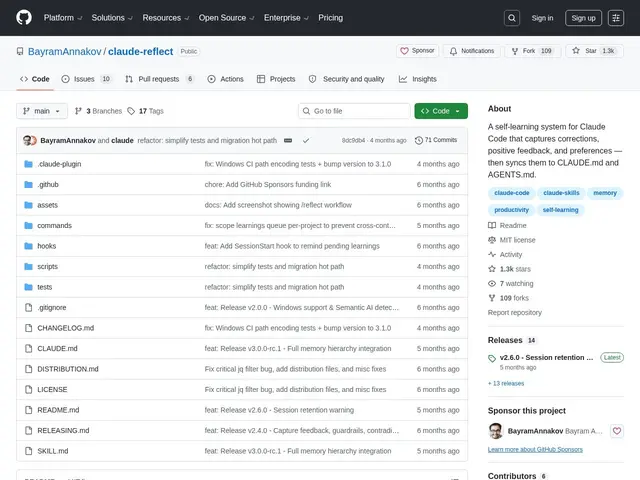
Description
Every time you correct an AI coding agent — 'no, use X instead' — that correction usually evaporates the moment the session ends, so you end up repeating the same guidance over and over. Claude Reflect is built to break that cycle by turning those corrections into permanent, reusable memory.
Claude Reflect is an MIT-licensed plugin for Claude Code that watches for correction patterns (using regex plus AI-based semantic validation) and repeated workflows in real time, queues detected learnings in a local file (~/.claude/learnings-queue.json), and then, after a manual review step via the /reflect command, syncs the validated changes into CLAUDE.md and project config files. It supports corrections given in multiple languages, including English and Spanish, and can detect recurring patterns worth turning into reusable Claude Code skills. It requires Python 3.6+ and works across macOS, Linux, and Windows. On GitHub it has around 1.3k stars and 109 forks, suggesting active adoption within the Claude Code community.
💬 Our review
The short version: if you're using Claude Code for long-running projects and keep re-explaining the same preferences session after session, Claude Reflect automates exactly the kind of memory-building that's usually done by hand-editing CLAUDE.md, and the manual review step keeps it from polluting your config with noise.
The realistic alternative is doing this manually — writing your own CLAUDE.md and AGENTS.md rules as you notice patterns, which works but requires you to remember to do it. Claude Reflect's edge is that it catches corrections passively as you work and queues them for review, rather than relying on you to stop and document a preference right when you notice it. Because it's tied specifically to the Claude Code ecosystem rather than being a general-purpose memory tool, it won't help if you switch to a different coding agent, and the semantic-validation step means it isn't purely deterministic — you'll want to actually read the queued learnings before approving them. For a solo developer or small team standardizing how Claude Code should behave on a specific codebase over many sessions, it's a genuinely useful, free addition with real community traction behind it.
📊 Global score
🤖 AI-enriched data
Entièrement gratuit, licence MIT, disponible comme plugin du marketplace Claude Code.
Pros
Capture automatique des corrections (regex + validation sémantique IA)
Détecte des patterns répétitifs pour suggérer des skills réutilisables
Support multilingue des corrections utilisateur (anglais, espagnol)
Synchro bi-directionnelle vers CLAUDE.md et fichiers config projet
1.3k stars GitHub, 109 forks, communauté active
Cons
Nécessite Python 3.6+ pour fonctionner
Dépend entièrement de l'écosystème Claude Code, pas générique
Requiert une curation manuelle via /reflect avant application