Navon
An AI-powered operational coordination platform for mid-market companies. Navon embeds AI into core business operations through automated workflows, approvals, and unified coordination across existing enterprise systems.
🔗 Visit Navon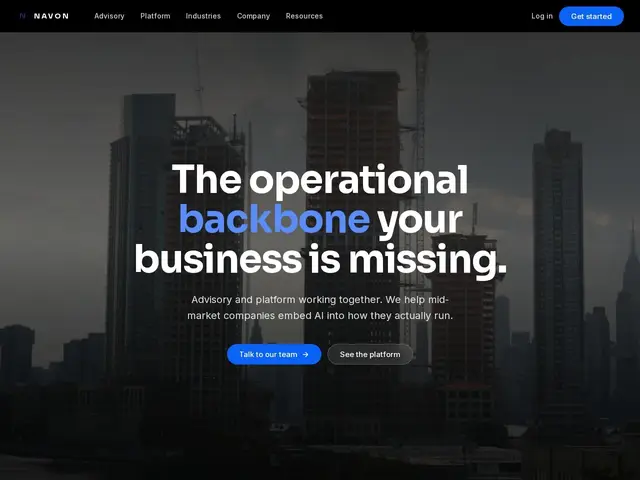
Description
Mid-sized companies running physically complex operations — like a construction firm coordinating subcontractors, approvals and paperwork across a dozen systems — often end up gluing everything together with spreadsheets and email chains. Navon tries to replace that patchwork with one coordination layer that sits on top of the tools a company already uses, routing approvals and updates automatically instead of someone having to chase them down manually.
Navon provides workflow automation, approval routing, operational intelligence dashboards, and cross-system coordination for operations-heavy mid-market businesses. Its Nova AI assistant proposes human-reviewed actions rather than acting autonomously, with integration layers connecting to existing CRMs, ERPs and other tools. It includes role-based access control, append-only audit trails, encrypted data with row-level security, and supports cloud, VPC, or on-premise deployment.
💬 Our review
The short version: Navon is a niche fit right now — it's proven itself specifically in construction operations, with other industries still in an advisory or early-access phase, so it's a stronger bet if you're in that vertical than as a general-purpose automation tool today.
Against Zapier and Make — both self-serve, with transparent per-task pricing and much broader off-the-shelf integration libraries, but neither built around human-approved AI actions or audit-grade compliance — Navon's differentiation is that human-in-the-loop, audit-first design. Pega, a larger and more established enterprise process-automation platform, shares a similar human-in-the-loop philosophy but comes with a much higher price and implementation overhead. Since Navon doesn't publish pricing and requires a sales conversation, it's aimed at mid-market operations teams evaluating a real deployment, not something to self-serve trial the way you would with Zapier.
💰 Pricing
📊 Global score
🤖 AI-enriched data
Pricing is not publicly listed; appears to be custom per engagement based on company size and industry vertical.
Pros
Combines workflows, approvals and cross-system coordination in one platform
Human-first design: AI proposals require explicit approval, not autonomous action
Flexible deployment: cloud, VPC or on-premise
Audit-ready with encrypted data and row-level security
Data privacy guarantee — not used for model training or shared across organizations
Cons
Only construction has live deployments; other verticals are still in advisory phase
No self-service sign-up — requires direct engagement
Pricing isn't public, likely a high barrier to entry for smaller teams
US-only presence, no international availability indicated