SeeleAgent
AI-powered platform that transforms text prompts into complete, playable 3D games and supporting assets. Generates code, 3D models, textures, animations, audio, and marketing materials from natural language descriptions.
🔗 Visit SeeleAgent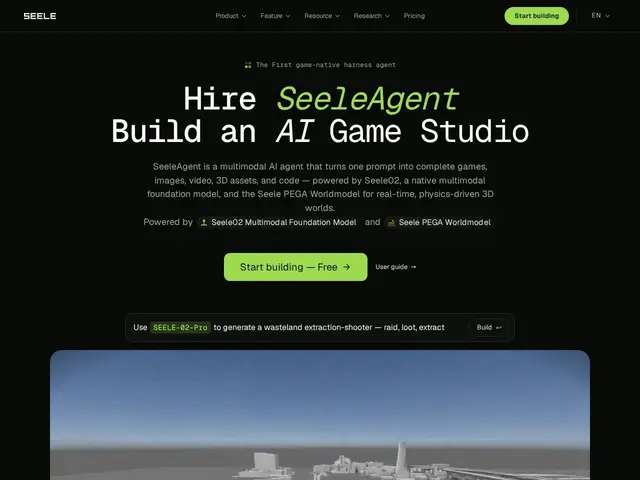
Description
Making even a simple video game normally requires a small team — someone to model characters, someone to write game logic, someone to handle art and audio. SeeleAgent is built around collapsing most of that into a text prompt: describe the world, characters and mechanics you want, and it generates a playable game — assets, code and all — that you can then tweak or export to a real engine.
SeeleAgent is a multimodal AI creation agent generating end-to-end games (2D/3D, multiplayer-capable) with full asset pipelines including 3D models, textures, animations and rigging. It exports to Unity 6, Unreal and Three.js, with browser-based playtesting and real-time preview, plus a built-in IDE for inspecting and modifying generated code. It also generates supporting content like marketing videos, and integrates monetization via Stripe, PayPal, Alipay and AdSense. The platform runs on in-house proprietary foundation models rather than third-party APIs.
💬 Our review
The short version: SeeleAgent is best understood as an ambitious end-to-end game prototyping tool rather than a production pipeline — going from a text prompt to something playable is genuinely impressive, but turning that into a polished, shippable game will still take real additional work.
Against Unity Muse (an AI assistant bolted onto an existing, mature engine you still need to know how to use), SeeleAgent's prompt-first approach needs no engine experience to get started, at the cost of less fine-grained control once you want to go beyond the generated baseline. Against a narrower tool like Tripo AI, which generates individual 3D assets rather than whole playable games, SeeleAgent is the better fit if you want a complete prototype fast, and Tripo is better if you already have a pipeline and just need assets to drop into it. Since specific pricing isn't published beyond a free credit tier and an unpriced Pro tier, it's hard to judge value for money precisely — worth testing the free tier's output quality on a real idea before assuming it replaces any paid tooling.
💰 Pricing
📊 Global score
🤖 AI-enriched data
Free tier provides credits for building, playing and sharing projects across all modalities. Pro plans offer faster generation, advanced models, larger storage and Unity export — specific prices not publicly listed.
Pros
Generates complete, playable games from a single text prompt
Multimodal output: games, videos, audio, code and marketing materials
Ranked #1 on public Godot game-dev benchmarks
Multi-engine export: Unity 6, Unreal, Three.js
Browser-based with real-time preview and a built-in code IDE
Built-in monetization integration
Cons
Specific pricing details aren't publicly disclosed
Free tier credit limitations aren't clearly detailed
Getting from prototype to a polished, shippable game still takes real extra work