HyperDX
Open-source observability platform combining session replays, logs, traces, metrics, and errors in a unified interface. Built on ClickHouse and OpenTelemetry as a cost-effective alternative to Datadog and New Relic.
🔗 Visit HyperDX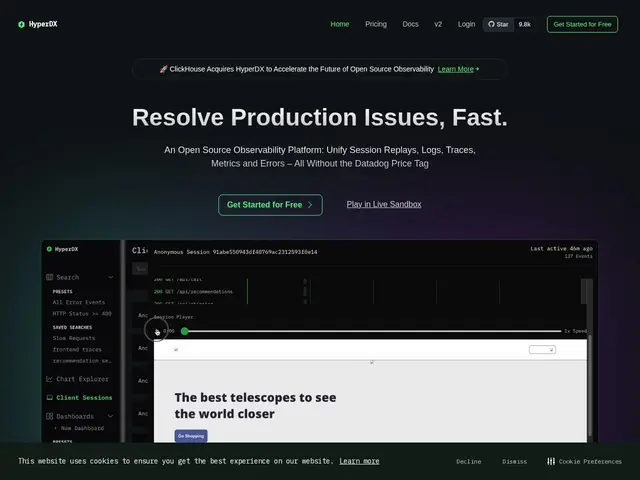
Description
Debugging a slow or broken app in production usually means jumping between three or four separate tools — one for logs, one for error tracking, one for performance traces — and manually piecing together what happened from each. HyperDX puts logs, traces, metrics, errors and session replays into a single searchable timeline, so you can follow one user's broken request from their browser all the way through your backend without switching tabs.
HyperDX automatically traces requests from browsers and mobile devices through backend servers and background workers, built on ClickHouse and OpenTelemetry for vendor-agnostic instrumentation. It offers real-time session replay correlated with backend data, full-text search across logs and traces, automatic pattern clustering across billions of events, a chart builder for visualization, and multi-platform alerts (Slack, email, PagerDuty). It's open source (MIT license), available self-hosted or as a managed cloud service, and was recently acquired by ClickHouse.
💬 Our review
The short version: HyperDX is worth a serious look if Datadog's per-host, per-seat pricing has gotten out of hand for your team — it covers the same core observability signals at roughly a tenth of the cost, with the trade-off of a smaller plugin ecosystem.
Against Datadog and New Relic — the established, feature-rich incumbents with huge integration marketplaces but notoriously expensive per-host pricing — HyperDX's usage-based model ($0.40/GB, no per-seat fees) is a genuinely different cost structure worth modeling against your actual data volume. Against Grafana/Prometheus, which are also open source, HyperDX's advantage is that logs, traces and metrics come unified out of the box rather than stitched together from separate tools. The free tier's 3GB/month will be exhausted quickly by any real production app, and self-hosting requires real technical setup, but being freshly acquired by ClickHouse is a strong signal for continued investment even though it's still young next to Datadog's decade-plus track record.
💰 Pricing
📊 Global score
🤖 AI-enriched data
Free: 3 GB/month, 3-day retention, 1 user, 14-day trial. Starter: $20/month base for 50 GB/month, 30-day retention, unlimited users, additional data $0.40/GB. Enterprise: custom pricing with volume discounts, SAML SSO, flexible retention. Metrics billed at $0.40 per 100 metrics (1 DPM). Roughly 10x cheaper than Datadog for equivalent usage.
Pros
Unifies logs, traces, metrics, errors and session replay in one interface
Usage-based pricing with no per-seat or per-host charges
Open source (MIT license) with active development
Built on ClickHouse for high-performance analysis at scale
Roughly 10x cheaper than Datadog for equivalent usage
Self-hosted or cloud deployment
Cons
Smaller plugin/integration ecosystem than Datadog or New Relic
Self-hosting requires real technical setup
Free tier limited to 3 GB/month and 1 user
Younger project than the established incumbents