T-Rex Label
An AI-powered annotation platform that accelerates dataset labeling for computer vision projects using zero-shot object detection. Browser-based tool requiring no installation.
🔗 Visit T-Rex Label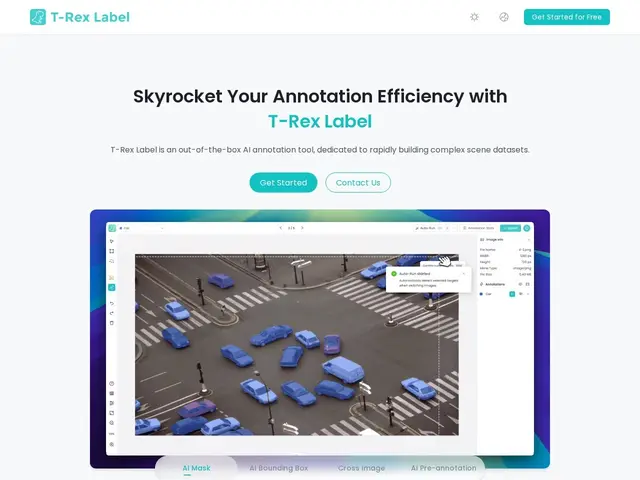
Description
Training a computer vision model usually starts with a tedious job: drawing boxes around every object in thousands of images, one at a time, by hand. T-Rex Label tries to shortcut most of that — you show it one example of what you want labeled, and it proposes the same labels across a whole batch of similar images automatically, turning what used to be hours of manual boxing into a much shorter review-and-correct pass.
T-Rex Label is a browser-based visual annotation platform powered by the T-Rex2 zero-shot detection model. Users apply a visual prompt once and the platform propagates annotations across multiple images without any fine-tuning or model retraining required. It supports export to common formats and platforms including Kaggle, Roboflow, Hugging Face, TensorFlow and PyTorch, and runs entirely in-browser with zero setup. It's used across industries like agriculture, logistics, healthcare, retail, construction, electronics and transportation for labeling datasets that feed downstream ML models.
💬 Our review
The short version: T-Rex Label is worth trying if manual bounding-box annotation is your real bottleneck — the zero-shot propagation trick genuinely saves time over labeling every image from scratch, even if you'll need to test the free tier before deciding if it fits your workflow.
Its closest competitors — Roboflow, Labelbox and SuperAnnotate — are broader end-to-end MLOps platforms with published, self-serve pricing, whereas T-Rex Label is narrower and requires contacting sales to get actual numbers. That opacity is the main knock against it: you can't compare cost against Roboflow's transparent tiers without a sales conversation first. What tips it back in T-Rex Label's favor is that the zero-shot, no-fine-tuning workflow is a genuinely distinct approach for teams who don't want to invest in training a custom labeling model just to speed up annotation.
💰 Pricing
📊 Global score
🤖 AI-enriched data
Free tier available to start. Specific paid plan names and prices are not published on the website; contacting sales is required for detailed pricing.
Pros
Zero-shot detection requires no model fine-tuning or retraining
One visual prompt propagates annotations across a whole batch of images
Fully browser-based, zero installation or setup
Supports major dataset formats and platforms (Kaggle, Roboflow, HuggingFace, TensorFlow, PyTorch)
Effective at detecting rare objects from very few annotation samples
Cons
Detailed pricing isn't published — requires contacting sales
Free tier limitations aren't clearly documented
Narrower scope than full MLOps annotation platforms like Roboflow