Relevance AI
Platform for building and running teams of specialized AI agents that handle real business work in sales, support, marketing, HR and operations.
🔗 Visit Relevance AI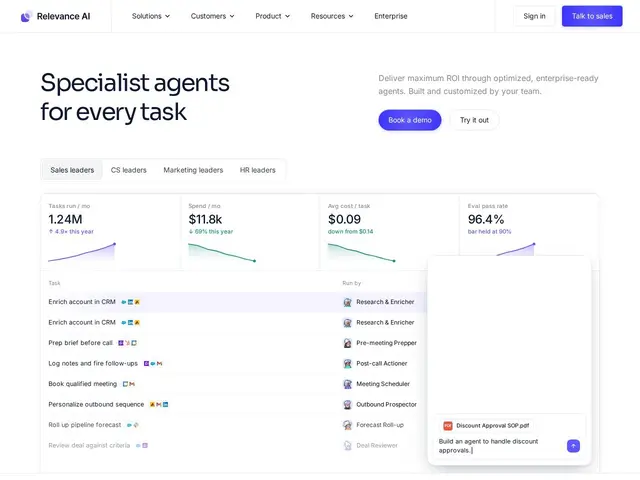
Description
Instead of hiring a person or writing custom software for a repetitive job — qualifying leads, answering support tickets, screening resumes — Relevance AI lets a company assemble an AI agent to do it, using pre-built templates rather than starting from a blank page. Think of it as a staffing agency for software robots: you pick a role, connect it to the tools you already use, and it goes to work with a human able to step in and approve or override at any point.
Under the hood, Relevance AI routes each task to whichever LLM is most cost-effective for that specific job rather than locking into a single model, reporting a 96.4% quality pass rate across tasks. It connects to 1,000+ business apps (Salesforce, HubSpot, Slack, Gmail among them), includes human-in-the-loop approval steps, version control for agent behavior, and real-time performance monitoring, with enterprise security (SOC 2, GDPR, SSO/SAML, PII masking) aimed at regulated buyers. Deployment follows a roughly six-week methodology with an embedded team, rather than a self-serve signup-and-go flow.
💬 Our review
The short version: Relevance AI is an enterprise-grade agent platform with real customer results (KPMG, Autodesk, Canva) behind it, but it's built for companies ready for a sales-led, multi-week rollout, not a weekend side project.
The multi-LLM router is the most genuinely useful technical decision here — most competitors lock you into one model's pricing and quality tradeoffs, while Relevance AI shops each task to the cheapest model that still clears its quality bar, which matters a lot at the volumes their case studies describe (1.24M tasks/month, $0.09/task). Backed by $15M in funding and validated by Forbes/TechCrunch coverage and a 4.5-star G2 rating, it's a credible enterprise pick. The tradeoff is that there's no visible self-serve or freemium path — everything funnels to a sales conversation and a 6-week deployment, which rules it out for teams wanting to test an agent idea today rather than next quarter. For that faster, cheaper experimentation, something like Zapier's agent features or a narrower tool like Pokee AI or CodeWords is a better starting point.
💰 Pricing
📊 Global score
🤖 AI-enriched data
Custom usage-based pricing; typical reported usage ~$11.8k/month for 1.24M tasks (~$0.09/task). Requires a sales consultation, no public self-serve tiers.
Pros
Multi-LLM router picks the cheapest model that still meets quality bar per task
1,000+ pre-built integrations with business-critical apps
Proven enterprise deployments (Qualified, KPMG, Autodesk, Canva)
SOC 2, GDPR, SSO/SAML and PII masking for regulated buyers
Cons
No public pricing or self-serve signup — sales consultation required
No clear freemium tier for smaller teams or quick experiments
6-week deployment methodology implies real setup time, not instant use