Jinba
Enterprise platform that turns plain-English descriptions of business processes into executable workflows, deployable as APIs or MCP servers.
🔗 Visit Jinba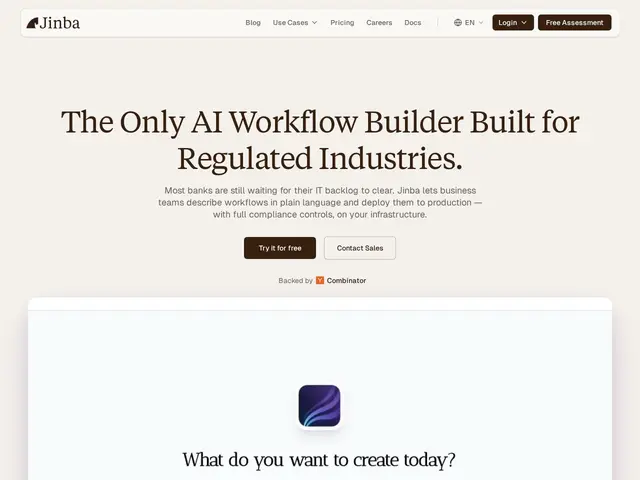
Description
Most companies have processes — like checking a loan application, screening a new hire, or reviewing an insurance claim — that live in someone's head or a messy spreadsheet, and turning them into real software normally means hiring developers and waiting weeks. Jinba lets someone describe the process in plain English and turns that description into a working piece of software that runs the steps automatically, the way you might explain a recipe to a friend and have them cook it exactly as described.
Jinba splits into two products: Jinba Flow, where technical teams build and refine workflows through a chat-to-flow generator plus a visual editor, and Jinba App, where business users run the already-approved workflows without touching the underlying logic. Finished workflows can be exposed as regular APIs or as MCP servers, so they plug into other AI agents. It ships with 100+ pre-built integrations, custom connector support, and enterprise controls (SOC 2 Type II, SSO, RBAC, audit logging), and can be deployed in the cloud, on-premise, or with a private-hosted AI model for organizations that can't send data to a third-party LLM.
💬 Our review
The short version: Jinba is a workflow builder for people who'd rather describe a business process in a sentence than drag boxes around a canvas, with the compliance paperwork (SOC 2, on-prem hosting) that regulated industries actually ask for.
The split between a technical builder (Jinba Flow) and a locked-down runner for business users (Jinba App) is a sensible answer to a real problem: most no-code tools let anyone edit the live workflow, which is exactly what compliance teams in finance, insurance, or healthcare don't want. The natural-language-to-workflow step is the main differentiator versus Zapier or n8n, but it's also the main risk — how well it works depends entirely on the underlying model correctly interpreting a fuzzy instruction into deterministic logic, and Jinba is vague on-site about failure rates or how much manual cleanup is typically needed after generation. Pricing is opaque beyond a fairly limited free tier (10 workflows, 100 daily copilot requests), so budget-fit is a sales conversation, not a self-serve decision — standard for enterprise workflow tooling but worth knowing going in.
💰 Pricing
📊 Global score
🤖 AI-enriched data
Free: $0/month (2 team members, 2 workspaces, 10 workflows, 100 daily copilot requests, 1,000 API credits). Mid-tier and Enterprise: custom pricing via sales.
Pros
Natural-language workflow description lowers the technical barrier to entry
Separate build (Flow) vs run (App) products limit who can edit live logic
SOC 2 Type II, SSO, RBAC and audit logging out of the box
Deployable as API or MCP server, plus on-prem/private-model hosting
Cons
Free tier capped tightly (10 workflows, 100 daily copilot requests)
Mid-tier and Enterprise pricing withheld — sales call required to know real cost
Output quality depends on the underlying LLM correctly parsing fuzzy instructions