CloudZero
A dashboard that connects your cloud and AI API bills directly to which product features or customers are actually driving those costs.
🔗 Visit CloudZero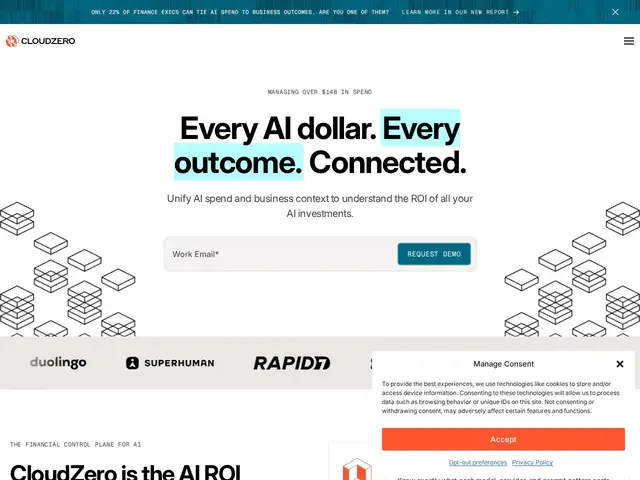
Description
Cloud bills are easy to see but hard to understand — you know AWS charged you $80,000 last month, but figuring out which feature, team, or customer actually caused that spend is a different problem entirely, especially now that AI API costs (OpenAI, Anthropic) are stacking on top of infrastructure costs. CloudZero is built to answer that why question: it pulls in spend data across cloud providers and AI vendors and maps it to the parts of your business that actually generated it, so finance and engineering can look at the same numbers and agree on what they mean.
CloudZero integrates with 40+ sources spanning AWS, Azure, GCP, and AI providers like OpenAI and Anthropic, offering multi-dimensional cost allocation, real-time anomaly detection, budgeting, forecasting, and outcome/unit-economics attribution — tying spend to revenue-generating activity rather than just infrastructure line items. It ships as a single subscription tier including unlimited users, cost sources, and dashboards, with real-time streaming telemetry at hourly granularity. Pricing is custom-quoted (no public numbers, no self-serve free trial). Customers include Coinbase, Duolingo, and Rapid7, with the company reporting over $14B in managed customer spend.
💬 Our review
The short version: CloudZero solves a real and growing problem — AI and cloud spend has become hard to attribute to anything meaningful — but it's an enterprise sales-led product, not something you sign up for and try in five minutes.
Against Finout (similarly enterprise-focused, strong on multi-cloud/SaaS unification) and cheaper self-serve options like Vantage, CloudZero's differentiator is its unit-economics framing — connecting spend to specific customers, features, or business outcomes rather than just tagging resources, which matters most for SaaS companies trying to understand per-customer margins. The lack of public pricing and absence of a self-serve free trial are real friction for smaller teams wanting to kick the tires before a sales call, and the value proposition depends heavily on having a finance/engineering team that will actually act on the unit-economics data. For mid-to-large companies with real cloud-and-AI spend complexity and a mandate to understand margins per customer, it's a strong (if opaque-pricing) option; smaller teams or those just wanting basic cost dashboards will find cheaper, more self-serve alternatives elsewhere.
📊 Global score
🤖 AI-enriched data
Un seul palier d'abonnement incluant utilisateurs, sources et dashboards illimités. Prix communiqué uniquement sur demande, pas d'essai gratuit en self-service.
Pros
Plus de 40 intégrations cloud et IA (OpenAI, Anthropic inclus)
Rattache les coûts aux revenus/clients réels (unit economics)
Télémétrie temps réel granularité horaire
Un seul plan avec tout inclus, pas de fonctionnalités bridées
Cons
Prix non public, nécessite un contact commercial
Pas d'essai gratuit en self-service
Courbe d'adoption pour aligner finance et ingénierie