Gumloop
A visual canvas for building AI-powered automations without writing code — drag together steps that pull data from your CRM, ask an AI model a question, and post the answer to Slack, similar to how Zapier connects apps but with an AI reasoning step built
🔗 Visit Gumloop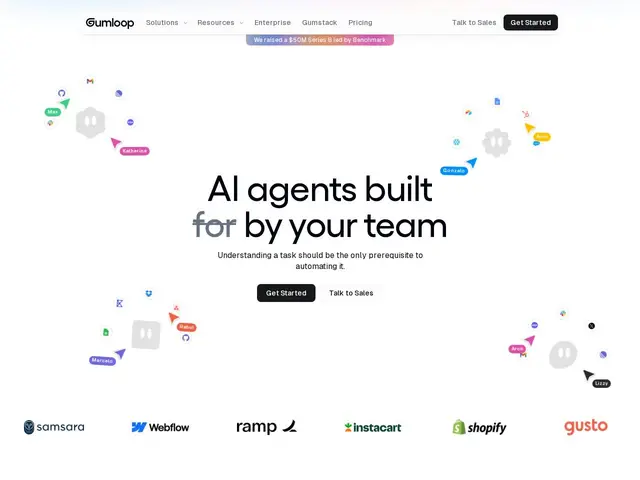
Description
Automation tools like Zapier are great at moving data between apps on a trigger, but they generally can't 'think' about that data — they can't summarize a document, judge whether a lead looks promising, or draft a reply. Gumloop's pitch is to combine both: classic app-to-app automation plus AI agents that read, reason, and generate content as steps within the same workflow, built visually on a canvas rather than in code.
It connects to 500+ tools including Salesforce, HubSpot, Stripe, and Snowflake, plus Slack, Microsoft Teams, and Gmail, and lets you choose between Claude, GPT, Gemini, or DeepSeek per workflow without vendor lock-in. An orchestration canvas supports multi-agent workflows for more complex processes, and enterprise features include SOC 2 Type II compliance, GDPR support, role-based access, VPC deployment, and a centralized 'Gumstack' AI gateway for monitoring and audit logging, with zero data retention for model training. Pricing is free to start, Pro at $37/month (20k+ credits, unlimited seats and workflows, 5 concurrent runs), and custom Enterprise pricing above that. The company has raised a $50M Series B led by Benchmark and counts Gusto, Instacart, Samsara, Shopify, Ramp, and Webflow among its customers.
💬 Our review
The short version: Gumloop is a strong pick if your automation needs go beyond simple triggers into tasks that require actual judgment — summarizing, qualifying, drafting — and the $50M Series B plus a customer roster including Shopify and Ramp suggests real enterprise traction rather than an early-stage bet.
Against Zapier and Make, which excel at connecting apps on triggers but treat AI as a bolt-on feature rather than a core building block, Gumloop is built model-first — you pick which LLM powers each step and can mix providers within one workflow, avoiding lock-in to a single AI vendor's roadmap. Against n8n, the leading open-source alternative, Gumloop trades self-hosting flexibility for a more polished enterprise feature set (SOC 2, VPC deployment, centralized audit logging) that matters more once you're automating processes that touch sensitive data. At $37/month for the Pro tier with unlimited seats, it's competitively priced for teams, though as with any credit-based AI automation tool, actual monthly cost depends heavily on how many AI-reasoning steps (versus simple data-moving steps) your workflows actually use. <!-- ai-generated -->
💰 Pricing
📊 Global score
🤖 AI-enriched data
Gratuit pour démarrer, Pro 37$/mois (20k+ crédits, sièges illimités), Enterprise sur devis. -20% en annuel.
Pros
500+ intégrations (Salesforce, HubSpot, Stripe, Snowflake) + Slack/Teams/Gmail
Choix du modèle IA par workflow (Claude, GPT, Gemini, DeepSeek), pas de verrouillage fournisseur
Levée de 50M$ (Series B, Benchmark) + clients reconnus : Shopify, Ramp, Instacart, Gusto
Conformité entreprise : SOC 2 Type II, GDPR, déploiement VPC, zéro rétention de données pour entraînement
Cons
Pas de self-hosting contrairement à n8n (open source)
Coût réel dépend du nombre d'étapes IA (vs étapes de données simples) consommées, moins prévisible
Positionnement plus entreprise que Zapier, potentiellement overkill pour un usage solo très simple
Prix Enterprise non public, à négocier au cas par cas