Command Center
A workspace built for the new problem AI coding tools created: your AI assistant can write code faster than you can read it, so Command Center adds guided walkthroughs and diff explanations that help you actually understand and trust what got changed befo
🔗 Visit Command Center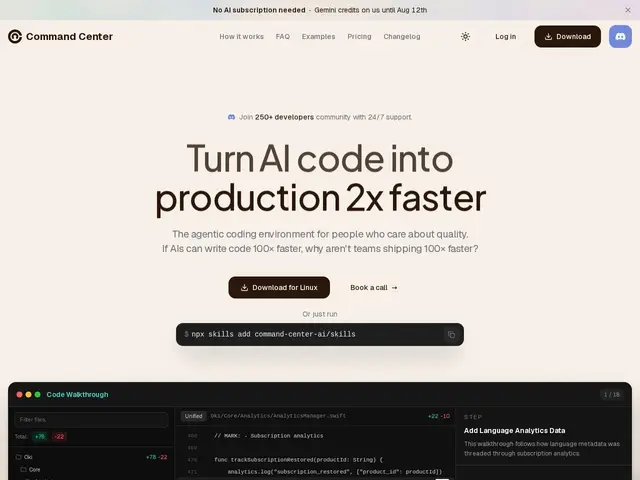
Description
AI coding assistants solved the 'writing code' bottleneck, but they created a new one: reviewing it. When an agent rewrites a dozen files in thirty seconds, a developer can easily spend the rest of the day just trying to understand what changed and whether it's safe to merge — the opposite of the speedup that was promised. Command Center's whole premise is that reading AI-written code, not writing it, is now the actual bottleneck, so it builds tooling specifically for that step.
It lets you run multiple coding agents (Claude, Codex, OpenCode, Cursor) side by side in one workflow, and generates guided walkthroughs — summaries, video previews, and interactive tours — that explain a large diff or pull request in plain language rather than making you read raw code line by line. A real-time diff viewer tracks changes as agents make them, with a pre-merge refactoring agent and parallel workspace management for running several tasks at once. It runs locally by default (code never leaves your machine unless you use their free Gemini credits, which aren't retained), and ships with git plus a modified OpenCode so it works even on an unconfigured machine. Pricing is a free tier with usage limits, Starter at $9/month, and Pro at $19/month for higher limits on walkthroughs, refactoring, and simultaneous workspaces.
💬 Our review
The short version: Command Center is worth trying specifically if your team has already adopted AI coding agents and found that reviewing their output, not generating it, is what's actually eating your time — it's a review and comprehension tool wrapped around the agents you already use, not a replacement for them.
Against Cursor, which bundles its own single AI model tightly into an IDE, Command Center's differentiator is being agent-agnostic — you bring Claude, Codex, or OpenCode and it wraps a review layer around whichever one you're already using, which matters if your team hasn't standardized on one tool yet. Against just reading raw diffs in GitHub or your IDE, the walkthroughs and video previews are a genuine time-saver for large AI-generated changes, though how much they help will depend on how well they explain your specific codebase's context versus generic diff summarization. At $9-19/month, it's cheap enough that the real question isn't cost — it's whether your team's actual bottleneck matches the problem it's built to solve. <!-- ai-generated -->
💰 Pricing
📊 Global score
🤖 AI-enriched data
Gratuit (limité), Starter 9$/mois, Pro 19$/mois
Pros
Compatible avec plusieurs agents IA (Claude, Codex, OpenCode, Cursor) dans un même workflow
Visites guidées et résumés vidéo pour comprendre un gros diff sans tout relire
Exécution locale par défaut, code privé sauf usage des crédits Gemini gratuits
Fonctionne même sur une machine non configurée (git + OpenCode inclus)
Cons
Ne remplace pas l'agent de code lui-même, seulement la couche de revue autour
Utilité dépend fortement du fait que la revue de diff soit vraiment votre goulot d'étranglement
Produit très récent (2026), peu de recul sur la fiabilité long terme
Communauté encore petite (250+ sur Discord)