Awish
An automation tool you talk to instead of configure — you describe what you want done in plain language, and it builds and runs the workflow, checking in with you over WhatsApp, Slack, or Telegram instead of a separate dashboard you have to remember to op
🔗 Visit Awish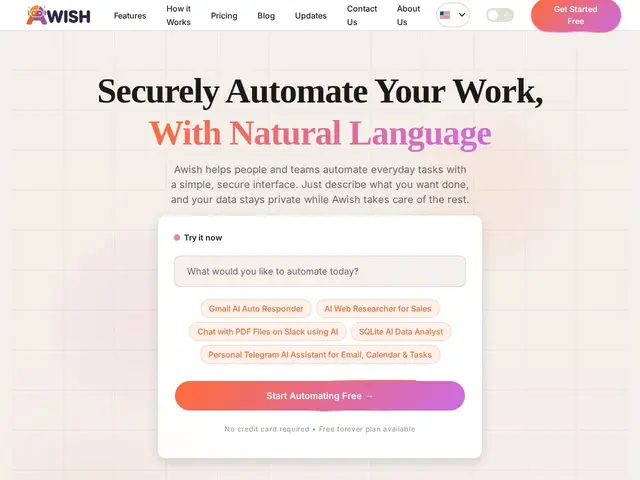
Description
No-code automation tools like Zapier are genuinely powerful, but building a workflow still means clicking through a builder interface, understanding triggers and actions, and testing it yourself. Awish's approach is to skip the builder entirely: you describe the task in natural language, an AI agent picks the right apps from its 500+ integrations, and it launches the workflow — with ongoing management happening through chat apps people already have open all day (WhatsApp, Slack, Telegram) rather than a dashboard you have to remember exists.
It uses a permission-first security model, asking for access app-by-app rather than presenting one intimidating blanket OAuth screen upfront, runs continuously (24/7 execution), and lets you refine an automation conversationally after it's built rather than starting over. Pricing is credit-based: Free (400 credits/month), Basic $29/month (2,000 credits), Standard $79/month (6,000 credits), Premium $199/month (20,000 credits), and custom Enterprise, plus one-time credit packs from $9-179 and 20% off on annual billing. It's backed by the NVIDIA Inception Program with partnerships including OpenAI, Anthropic, and AWS.
💬 Our review
The short version: Awish is worth trying if building workflows visually in Zapier or Make has ever felt like more setup than the task deserved — describing what you want in a sentence and having it built for you is a meaningfully lower barrier, especially for people who aren't going to learn a builder interface's quirks.
Against Zapier and Make, both of which require you to manually assemble triggers and actions in a visual builder, Awish's natural-language approach trades some precision control for speed of setup — useful for straightforward automations, though complex multi-branch logic may still be easier to reason about in a visual canvas where you can see the whole flow at once. The chat-native management (WhatsApp, Slack, Telegram) is a genuinely different interaction model that suits people who'd rather text an instruction than log into a web app, though it also means your automation instructions live inside a chat thread rather than a structured, easily auditable list. Backing from NVIDIA's Inception Program and partnerships with OpenAI and Anthropic are reasonable credibility signals for a young company, but as with any credit-based pricing, model your expected usage against the tier credit limits before committing — natural-language automation can consume more AI credits per task than a simple rule-based trigger would. <!-- ai-generated -->
💰 Pricing
📊 Global score
🤖 AI-enriched data
Gratuit 400 crédits/mois, Basic 29$/mois (2000 crédits), Standard 79$/mois (6000 crédits), Premium 199$/mois (20000 crédits), Enterprise sur devis. -20% en annuel.
Pros
Description en langage naturel, pas de builder visuel à apprendre
Gestion continue via WhatsApp, Slack ou Telegram, pas de dashboard séparé à ouvrir
Modèle de permissions app par app, pas d'écran OAuth global intimidant
Soutenu par le NVIDIA Inception Program, partenariats OpenAI/Anthropic/AWS
Cons
Moins de contrôle visuel qu'un builder Zapier/Make pour une logique multi-branches complexe
Instructions vivant dans un fil de chat, moins auditable qu'une liste structurée
Consommation de crédits potentiellement plus élevée par tâche qu'un déclencheur simple
Entreprise jeune, peu de recul sur la fiabilité long terme