Spice AI
A data platform that lets an AI agent or application query all your different databases and data sources with one SQL question — combining search, filtering, and even AI model calls right inside the query — without the usual months-long project of buildin
🔗 Visit Spice AI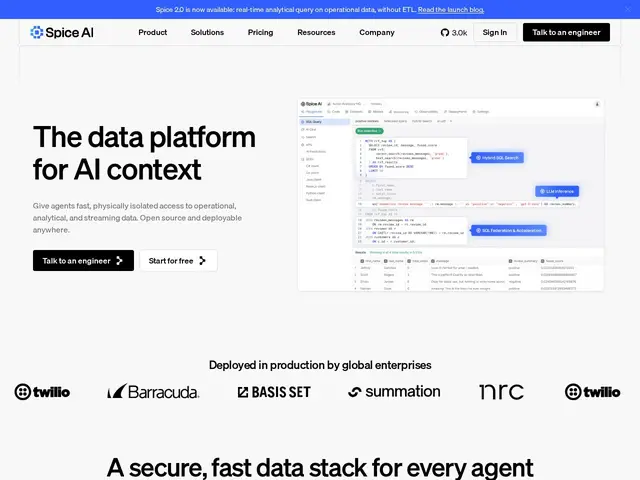
Description
Getting data ready for AI agents or analytics traditionally means ETL — extract, transform, load — a whole engineering discipline built around copying data from scattered sources into one central warehouse before you can query it usefully. Spice AI's pitch is to skip that step: it federates SQL queries directly across your existing operational data sources in real time, so you query live data where it already lives instead of maintaining a separate synced copy.
Beyond straightforward SQL federation and acceleration, it supports hybrid search combining vector, full-text, and keyword search in a single query, and can embed LLM inference calls directly inside SQL — letting an AI agent get both structured data and a model's interpretation of it in one round trip. It includes secure AI sandboxing for safely letting agents run generated queries, real-time change data capture, and edge-to-cloud deployment options with distributed observability. It's open source (Apache 2.0, github.com/spiceai/spiceai) founded by Luke Kim, with usage-based cloud pricing and a custom Enterprise tier that includes SOC 2 Type II compliance and a 99.9% uptime SLA; it's already deployed by companies including Twilio, Barracuda, and NRC Health.
💬 Our review
The short version: for teams building AI agents that need live access to data spread across multiple systems without the overhead of a full ETL pipeline, Spice AI's federation-plus-embedded-inference approach is a legitimate architectural shortcut — and real production users (Twilio, Barracuda) lend it credibility beyond a typical early-stage open-source project.
Against Databricks or Apache Spark, which are built around the traditional model of centralizing data before processing it, Spice AI's real-time federation approach is the fundamental difference — you're querying data in place rather than copying it first, which saves engineering time but means your query performance depends on the underlying source systems' own speed and availability. Against Rockset or Firebolt, both of which focus on fast real-time analytics on already-ingested data, Spice AI's edge is the embedded LLM inference and hybrid search directly in SQL, which is a more AI-agent-native feature set than either offers. Being open source under Apache 2.0 means you can self-host and evaluate at zero licensing cost before ever touching the paid Cloud or Enterprise tiers, which is the right way to validate whether federation actually performs well enough for your specific data sources before committing budget to the managed offering with its SOC 2 and SLA guarantees. <!-- ai-generated -->
💰 Pricing
📊 Global score
🤖 AI-enriched data
Open source Apache 2.0 gratuit ; Cloud facturé à l'usage (paliers non publiés) ; Enterprise sur devis avec SOC 2 Type II et SLA 99,9%
Pros
Fédération SQL temps réel — pas besoin de pipeline ETL préalable
Inférence LLM intégrée directement dans les requêtes SQL
Recherche hybride (vecteur, texte intégral, mots-clés) en une seule requête
Déployé en production par des entreprises établies (Twilio, Barracuda, NRC Health)
Cons
Performance des requêtes dépend de la disponibilité/vitesse des systèmes sources fédérés
Tarification Cloud à l'usage non détaillée publiquement
Moins adapté que Databricks pour du traitement batch massif centralisé
Fonctionnalités entreprise (SOC 2, SLA) réservées au tier payant