SciStudio
A free, open-source visual workspace for scientists that tries to bring together the scattered tools researchers normally juggle — notebooks, plotting, data pipelines — onto one collaborative canvas, instead of switching between five separate apps to go f
🔗 Visit SciStudio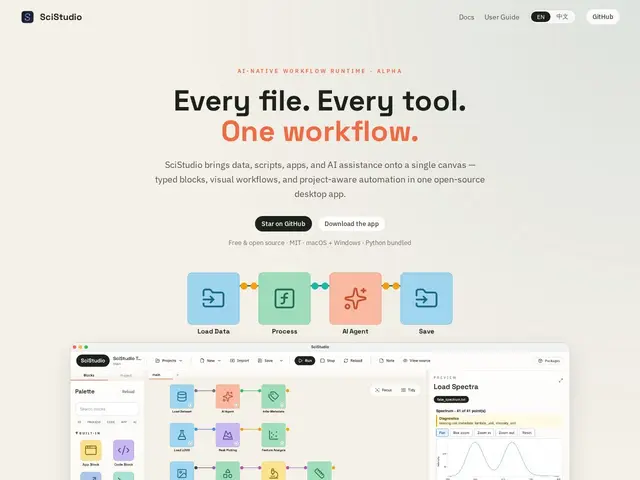
Description
Scientific research workflows are often a patchwork: raw data in one tool, cleaning scripts in a notebook, plots in another program, and collaboration happening over email or shared drives instead of the analysis itself. SciStudio's premise is a single "workflow canvas" — a visual, unified interface for building a scientific analysis pipeline end to end, so a research team can work on the same living document instead of stitching disconnected tools together.
It's built around a workflow-canvas concept for chaining together analysis steps, with AI-powered capabilities baked in and collaboration features aimed at research teams working together rather than individual scientists working alone. It's free and open source, hosted on GitHub under creator jiazhenz026, with community channels on Slack and Discord for support and discussion. It's worth being upfront that this is an early-stage project: the landing page currently has minimal documentation, some placeholder content is still visible, and there's no commercial or sustainability model disclosed — this looks like an ambitious solo or small-team open-source effort rather than a polished, funded product.
💬 Our review
The short version: the idea of unifying scattered scientific tools into one collaborative canvas is a genuinely useful problem to solve, but this is clearly an early-stage, likely solo-maintained project — worth watching or contributing to on GitHub rather than depending on for time-sensitive research right now.
Against JupyterLab, the closest and most widely-used comparison, SciStudio's pitch is unifying the workflow into one visual canvas rather than JupyterLab's cell-based notebook model, which could be a meaningful usability improvement if fully realized — but JupyterLab has a massive, mature ecosystem of extensions, kernels, and institutional trust that a new project can't match yet. Against RStudio or MATLAB, which are established, well-funded commercial or long-maintained tools with deep statistical and engineering libraries respectively, SciStudio is unproven at any comparable depth. Being free and open source means there's no financial risk in trying it, and for a small lab or student project willing to accept some rough edges (minimal docs, visible placeholder text on the landing page), it might be worth exploring or even contributing to directly — but for a research group with deadlines or funding dependent on reliable tooling, sticking with JupyterLab or RStudio until SciStudio matures further is the safer call. <!-- ai-generated -->
💰 Pricing
📊 Global score
🤖 AI-enriched data
Aucun coût, hébergé sur GitHub, aucun modèle commercial annoncé
Pros
Gratuit et open-source
Canvas de workflow unifié — une seule interface pour toute la pipeline d'analyse
Fonctionnalités IA intégrées et orientées collaboration d'équipe
Communauté active sur Slack et Discord
Cons
Projet très jeune — documentation minimale, contenu placeholder encore visible sur le site
Maturité et pérennité incertaines, pas de modèle de financement
Écosystème d'extensions/plugins bien plus restreint que JupyterLab
Semble porté par un créateur seul ou une petite équipe — risque de maintenance